|
|
The Vanadium Flow Battery The old...
The rechargeable lead-acid battery, invented in 1859, is still the one
of the most common methods of storing energy. However, even though there
have been many improvements made to the original 1859 battery, the lead-acid
battery is far from ideal.
Even since the lead acid battery was invented, chemists have been trying to make a better battery. While quite a wide variety of cells for small devices such as cell phones, hearing aids, cameras and computers have been developed; nothing has rivalled the lead-acid battery for large-scale energy storage. Until now, that is. And the new...
Professor Maria Skyllas-Kazacos is an Australian chemist specialising in
electrochemistry. In 1984 she started working on a new style of battery called
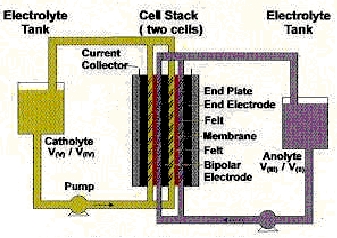
a redox flow cell. In flow cells, the half-cells are separated by a membrane
and the reagents for each half-cell are pumped through the stack of cells.
Both oxidised and reduced forms in each half-cell must be in solution.
The first flow cell investigated by scientists at NASA (National Aeronautic and Space Administration) laboratories in the USA was an iron-chromium cell, but they soon discovered an fundamental problem with flow cells — there would always be some transfer of reagents across the membrane. Maria and her team realised that what was needed was a combination of half-cells where it wouldn’t matter if the reagents did mix. The answer was to use vanadium, which exists in four oxidation states — all soluble. On one half-cell vanadium (V) is reduced to vanadium (IV), while in the other half-cell vanadium (II) is oxidised to vanadium (III). Any ion that migrates across the membrane is quickly oxidised or reduced to the required state, so no long-term contamination occurs.
Each cell produces a voltage of 1.4–1.6 V (depending on the concentration of the solutions). The desired voltage can be produced by combining a large number of cells together in a cell stack — all connected filled by the same electrolyte tank and pump. Vanadium is a relatively cheap and abundant metal and while the higher oxidation states of vanadium are toxic, vanadium flow batteries are very much safer than lead-acid batteries, because they do not need to be pulled apart and rebuilt every 2–3 years. The electrolyte solution can be charged and discharged indefinitely. The only part likely to require replacing are the cell membranes — about every 8–10 years. Like lead-acid batteries, vanadium flow batteries are charged by reversing the current flow, however flow batteries can also be recharged simply be replacing the spent electrolyte solution with fresh solution. So, for example, an electric car could be powered by a vanadium flow battery. Under normal use, the owner drives the car during the day, then recharges the battery overnight using cheap night-rate electricity. However, in an emergency (perhaps the owner forgot to plug it in overnight, or they’ve driven further than usual), the electrolytes in the tanks can be replaced at a service station within minutes. There are vanadium flow batteries in a number of locations around the world:
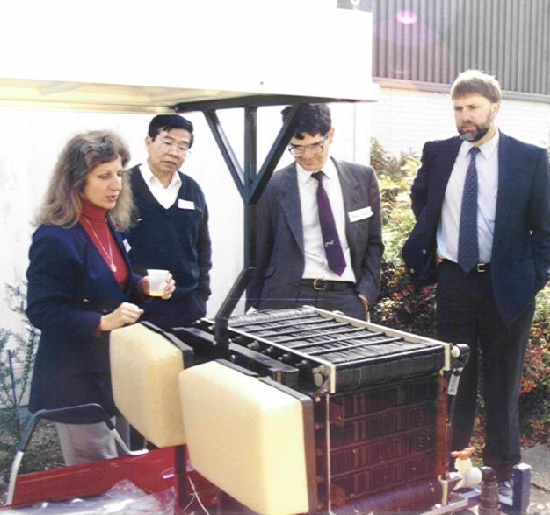
This golf cart is powered by a vanadium flow battery.
|
||||||
|
Maria Skyllas
Maria Skyllas was born in Greece in 1951, but her family moved to Australia when she was two and a half. Her family put a high value on education and encouraged their children to work hard at school. As a young teenager though, Maria thought she might leave school to become a hairdresser, or a fashion designer, or even a commercial artist. It was only after being encouraged to stay on at school that she began to enjoy the more academic subjects. Although she was enjoying the work, she was secretly afraid that it was too hard for her, and that the only reason she did well was because she worked very hard. Even when she got excellent marks at school, and continued to succeed at university, it took several years before she started to believe that she really did have the ability to do well, and that she could afford to relax a little.
After completing her degree in industrial chemistry, Maria encouraged her family to return to Greece. She got a job as a chemist almost immediately, but the rest of the family weren’t so fortunate, and not long after they arrived war broke out between Greece and Turkey. After only a few months, the family decided it would be better to return to Australia. Maria wasn’t quite sure what to do next, so she dropped in at the university to visit old friends. One of her lecturers encouraged her to do a PhD, rushing through the paper work for her so that she could start quickly. When she had no idea what topic to study, he suggested the electrochemistry of molten salts. It was a topic she’d never have chosen for herself, but as she started working on it, she became more and more interested. That PhD led to further research in electrochemistry, solar cells and energy storage. Eventually she returned to University of New South Wales as a lecturer, and today she is a Professor at the School of Chemical Sciences and Engineering and Industrial Chemistry and director of the Centre for Electrochemical and Minerals Processing. Two of the biggest problems facing the world today are those of pollution and energy. Maria’s battery helps in both of these areas, because it is less polluting than the lead-acid battery, and because it stores the energy obtained from renewable sources such as solar and wind power. It’s lucky for us all that Maria listened to those advisors who encouraged her to take the ‘hard’ subjects like maths and chemistry, to go to university, and to go back and get her PhD. And as for the art and fashion she loved as a teenager — well wearing a white coat in the lab does not prevent her from being stylishly dressed underneath it! |
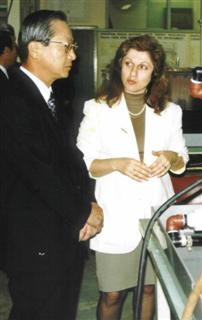 Maria discusses her flow battery with a Japanese investor.
|
||||||
|
|