|
|
Sniffing out trouble
In a basement laboratory at Canterbury University, Professor Murray McEwan
leads a small team of PhD and Masters students who have developed a new way
to determine the concentration of volatile organic compounds (VOCs) in gas
samples. Their technique, called Selected Ion Flow Tube Mass Spectrometry
(SIFT-MS) is being developed for use in such diverse fields as:
|
|
|
|
Although SIFT-MS is ideally suited to detecting volatile organic compounds,
Murray McEwan is a physical chemist whose primary interest is in the chemistry
of inter-stellar gas clouds. He is currently part of the team interpreting
results from the Cassini space mission to Titan (Saturn’s largest moon — which
has an atmosphere quite unlike that of Earth). To study these gas mixtures,
McEwan has to recreate them in his laboratory. In doing so, he has learnt
a great deal about what happens when small, positively-charged ions interact
with larger molecules under very low pressure. A few years ago, he realised
that the instruments being used to create and study extra-terrestrial gas
reactions could also be used by other chemists to find the concentrations
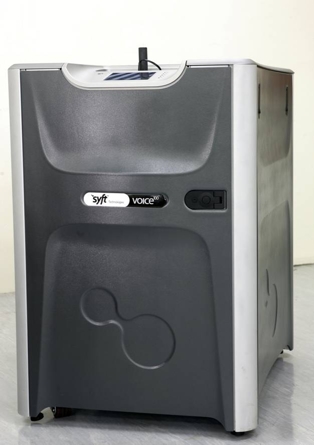
of known compounds. A commercial company — Syft Technologies Ltd, was set
up to develop and market the device. The instrument was redesigned to fit
into a much smaller space. Instead of filling a room, the new machine fits
under a bench, and is only a little larger than a domestic dishwasher.
|
|
||
|
How does it work?
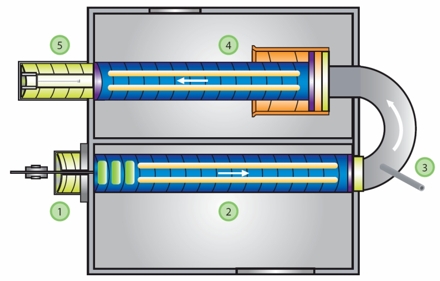
A small amount of air is taken into the reaction tube at 1 and ionised using microwaves. It passes through charged rods (2) which act like a sieve to trap all but the required precursor ion (H3O+, NO+ or O2+). The sample gas mixture is injected at 3. Gases in this mix react with the ion added and pass through to another ‘sieve’ at 4, only allowing through those particles of interest through to the detector at 5. The detector in conjunction with the ‘sieve’ records the mass of each charged particle that lands on it (uncharged particles are not detected) while also counting each particle. The functional groups on the VOCs react differently with each precursor ion, so by reacting the gas mixture with each ion in turn, it is possible to differentiate between isomers:
Propanone or propanal?
Both propanone and propanal react with H3O+ to form particles with a mass of 59:
A winning company
CH3COCH3 + H3O+ CH3CH2CHO + H3O+ But when each compound is reacted with NO+ the products are different: propanone forms a product with a mass of 132 while propanal forms a product with a mass of 57: CH3COCH3 + NO+ CH3CH2CHO + NO+ NO+ can also distinguish between isomeric esters such as ethyl propanoate, and propyl ethanoate. Ethyl propanoate combines with NO+ to form ions with masses of 132 and 59, while propyl ethanoate forms ions of masses 132, 43 and 101.
The company, Syft Technologies Ltd, was established in 2002 to develop and sell SIFT-MS to the world. (The change from SIFT to Syft was made because ‘sift.com’ already existed but ‘syft.com’ did not.) Since then, they have won a string of awards including the Innovative Product Award at the 2004 New Zealand Hi Tech Awards, and the prestigious Deal of the Year Award from Export New Zealand in 2006 for the $2 million contract to supply instruments to the Australian Customs Service to monitor fumigant levels in cargo containers. Also in 2006, Professor McEwan was awarded the Pickering Medal from the Royal Society of New Zealand. This medal is given to a person whose work, done in New Zealand , has influenced or changed the way things are done both nationally and internationally.
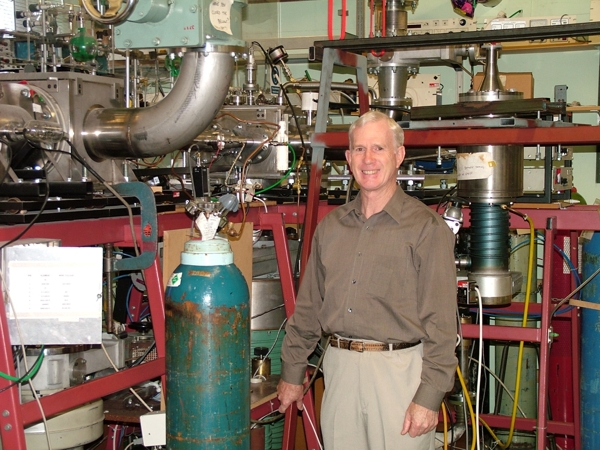
Murray with the original SIFT-MS equipment.
|
|||
| Murray McEwan
Murray McEwan went to Christchurch Boys’ High School, where he got reasonable marks in all his subjects. After three years though, he left school and got a job at the Health Department, to help support his family after the death of his father. Fortunately, Murray ’s uncle urged him to go to night school to gain University Entrance (in other words, complete Year 12). It was hard work fitting in hours of school work on top of his job, but Murray persevered and was one of the few night school students to succeed in gaining UE in one year. Of course, that meant he had the potential to do well at university, so Murray started working towards a science degree, with his employer giving him time off work to attend classes. He carried on juggling work and part-time study for two more years before he was able to enrol as a full-time student. Once he was able to concentrate on his courses, his ability really became evident, especially combined with the discipline learned during those earlier years.
Murray enjoyed both physics and chemistry, but became a chemist because his friends were studying chemistry. He carried on studying, completing his Masters and PhD in chemistry at Canterbury , and then accepting a scholarship with a group in a Toronto University investigating space science who were interested in how chemistry occurred in space in interstellar clouds). After Canada , he returned to Canterbury University as a lecturer in physical chemistry, where, apart from several periods between 1980 and 2004 at the Jet Propulsion Laboratory in the United States (where space research is done), he has remained. Today Murray’s juggling skills are once more required as he combines his roles as a lecturer in chemistry with his atmospheric researches and his work as Chief Scientist for Syft Technologies. He finds satisfaction in each of these jobs and has no regrets in following his friends into chemistry. |
|||
|
|
 CH3COHCH3+ + H2O