
| |
Sodium percarbonate – a modern bleach
Bleach
Household bleaches are used to either kill microbes or treat stains. A stain is a coloured mark that doesn't come out with ordinary washing.
Most of the stains on clothing are organic compounds containing double bonds. Oxidising bleaches break these double bonds and form diols which are colourless. The diols are also more soluble in water than their parent compounds, so oxidation makes it easier to wash the stain out. Chlorine-based bleaches are cheap, because chlorine is a by-product of the production of sodium hydroxide, which is produced in large amounts world-wide. However, although chlorine is a strong oxidising agent, effective in decolourising many stains and killing microbes, chlorine also reacts with a large number of organic compounds to produce many toxic compounds. These compounds form once the chlorine bleach has gone down the drain and entered the waste-water system. They end up in the ocean and become part of the food chain. As knowledge of the environmental damage chlorine can cause grows, there is a growing demand for non-chlorine bleaches. In recent years a wide variety of 'oxygen' bleaches have hit the New Zealand supermarket shelves. The active ingredient in most of these powders is sodium percarbonate, 2Na2CO3.3H2O2, which is an association of sodium carbonate and hydrogen peroxide, (in the same way as hydrated sodium carbonate, Na2CO3.10H2O is an association of sodium carbonate and water). Sodium percarbonate is a dry powder that dissolves in water to release hydrogen peroxide:2Na2CO3.3H2O2(s)
 4Na+(aq) + 2CO32–(aq) + 3H2O2(aq) 4Na+(aq) + 2CO32–(aq) + 3H2O2(aq) |

|
|||
|
Hydrogen peroxide
Hydrogen peroxide is a weak acid. Under alkaline conditions it hydrolises to produce HOO–
What about the carbonate?
HOOH(aq) + OH–(aq)
Hydrogen peroxide is a strong oxidising agent, effective in both killing microbes and oxidising stains. In alkaline conditions the half-equation is:
HOO–(aq) + H2O(l)HOO–(aq) + H2O(l) + 2e–
Any unreacted hydrogen peroxide is actually beneficial in waste-water systems because it removes free chlorine:
3OH–(aq) Cl2(aq) + H2O2(aq)
The oxygen produced helps aerobic bacteria to break down other nutrients in the water — an added benefit. O(g) + 2H+(aq) + 2Cl–(aq) Dilute hydrogen peroxide is sometimes added to fish tanks or hydroponic systems (where plants are grown without soil) as a source of oxygen. It rapidly decomposes to form oxygen and water: 2H2O2(aq)
That means that hydrogen peroxide-based cleaning products are safe to use in places where they might be washed onto a garden, or end up in a local river (via the storm-water system) — provided they are sufficiently diluted of course.
2H2O(l) + O2(g) Pure hydrogen peroxide is liquid at room temperature, both too reactive and too unstable to be used in a domestic laundry. By combining it with sodium carbonate to form sodium percarbonate, chemists have created a convenient powder that can be combined with other products and used safely.
Although hydrogen peroxide is the oxidising agent in sodium percarbonate, the carbonate ions have added benefits when mixed with detergents in the wash. Firstly, they precipitate out the calcium and magnesium ions often present in hard water. In the days when soap was used to wash clothes, these ions formed an insoluble scum that stuck to clothes and the machine and meant that much more soap was needed to get the clothes clean. Synthetic detergents do not form a scum in hard water, but the metal ions still combine with the detergent to reduce its effectiveness, so precipitating out these ions is still a good idea. Secondly, the carbonate ions raise the pH of the washing mixture. Both soaps and detergents are the salts of weak acids. In solution, these anions hydrolise in water, forming the acid:
Other uses of sodium percarbonate
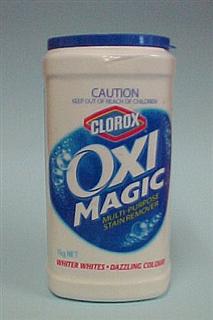
Sodium percarbonate is recommended as a laundry soaker or in-wash bleach, but it can also replace chlorine bleaches in many other household applications. Uses include:
|
 |
||||
|
Beverley Ruddick
Beverley Ruddick is one of New Zealand’s top stain scientists. For over thirty years she has been helping to solve the problems sent by commercial laundries and dry cleaners to the Research Institute of Textile Services (RITS). This organisation used to be partially funded by the government, but was purchased by Canesis Network in 1999 and is now part of AgResearch. She not only studies stains, but all sorts of problems associated with fabrics, whether before it is made up into a garment, how it performs when worn, how to care for it in the wash, and how to rescue it after damage has been done.
Beverley says she was a ‘dreamy girl’ who loved to read. She particularly enjoyed stories about famous scientists like Pasteur and Koch who made discoveries that had a big impact on people’s lives. From an early age she knew she wanted to be a scientist. The secondary school she went to was small and only offered senior chemistry, not physics or biology. Fortunately Beverley did well in chemistry, and was able to transfer to a larger school for her final year, where she was able to pick up Y12 physics and biology along with Y13 chemistry. While she recognised the need to have an understanding of the other sciences though, it was chemistry that drew her. At Victoria University she studied chemistry, organic chemistry, biochemistry, applied chemistry and biological chemistry! In her final year she worked on the structure of a compound produced by a fungus that, it was hoped, would be a new antibiotic. After completing her Masters in chemistry, she could have stayed on to do a PhD, but she decided that pure research didn’t interest her — she wanted to have a more immediate effect on people’s lives. Beverley went to work in one of the government laboratories of the DSIR (now broken up into a number of Crown Research organisations such as AgResearch). Her first task involved a problem facing apple growers, where apples would develop brown marks or ‘scalds’ under the skin. She worked on this for 15 months before leaving to have a family. A few years later took another DSIR position, working part time with the Pottery and Ceramics Research Association as librarian and lab assistant. It was a great job for someone who still loved to read. Beverley stayed with PACRA for four years, but although the science was interesting and varied, she felt cut off from the actual problems of real people. When a job was advertised with the then Research Institute of Launderers, Dyers and Dry Cleaners (later called RITS), Beverley applied — much to the surprise of many of her friends, who thought the more theoretical work of PACRA was of greater importance. Perhaps they were right, but Beverley has had great satisfaction in keeping up with the changes in textile technology, and providing a valuable service to a necessary industry — one that Pasteur himself also served. It’s obvious that Beverley loves her job. When RITS was purchased by Canesis and transferred from Wellington to Christchurch, she chose to leave her many friends and family and make the shift south, rather than find other work in Wellington. |
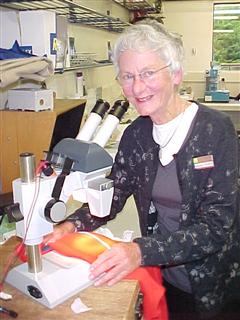
Beverley enjoys finding solutions to textile problems that cost New Zealanders money. |
||||
| |
 RCOOH + OH–