
|
|
Using phase change materials
Professor Arthur Williamson, from Canterbury University, is one of the
world’s leading thermodynamic scientists. He has a particular interest in
developing and promoting the use of phase change materials to reduce or even
eliminate energy costs in heating or cooling.
What are phase change materials?
The energy absorbed as a substance melts (enthalpy of fusion) is very much
greater than that required to warm the liquid. Water, for example, takes
4 J of energy to warm 1 g of water by 1° C, but it takes 333 J of
energy to melt 1 g of ice (and 2278 J to boil 1 g of water).
By choosing compounds that melt at the appropriate temperature, these phase change materials (pcm) can be used to stop equipment (or people) from overheating. Alternatively, the material can be melted and allowed to freeze. As it does so, it evolves heat at a constant temperature, thus keeping sensitive samples (or skiers) warm. |
||
|
Thermal batteries
Prof Williamson was approached by a NZ cell phone company looking for a
way to keep their equipment from overheating if their air conditioning units
broke down. Swedish company, Climator, had a suitable pcm, and
in conjunction with Williamson designed an aluminium capsule with many fins
(giving it a large surface area) to contain the pcm so that it would rapidly
absorb heat in an emergency. Then they simply used enough blocks to absorb
the energy produced by the equipment for the 45 minutes the company estimated
it would take to get a repair team out to the exchange box and install a
new refrigeration unit.
Climator is now using this design to make thermal batteries to protect equipment all over the world. Some of the batteries are used to create safe places within a building for people to shelter in when there is a fire. Other batteries are used to absorb heat during the afternoon, and return it during the evening, to maintain a comfortable temperature in buildings such as schools or libraries that otherwise would require air conditioners. Hydrated sodium sulfate is a good pcm for this purpose, since it melts at 32 °C. This can be modified with additives to as low as 21°C. |
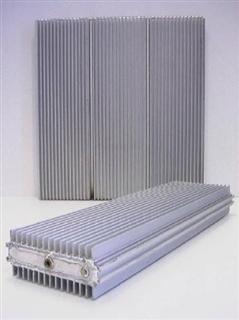
The design of this thermal battery allows for rapid heat transfer between the phase change material at its core and the surrounding air. |
||
|
Piping heat
Take a metal tube — ideally copper, but stainless steel will do — remove
the air, add a small volume of a volatile liquid and seal it. Now place the
bottom of the tube on a heat source and add cooling fins to the top. The
heat will cause the liquid to evaporate, absorbing large amounts of energy
and filling the tube. When it touches the cool top surface the vapour condenses,
trickling down the sides of tube to the bottom where it absorbs more heat.
A copper heat pipe is about 1000 times more efficient at conducting
heat than copper itself. They’re used in such diverse applications as keeping
the supporting legs of the cross-Alaska oil pipeline cold, so the ground
it sits on stays frozen, to helping to cool the components in a laptop computer.
In places (such as a laptop) where gravity cannot be used to return the liquid
to the heat source, capillary wicks do the same job.
Professor Williamson used the principle of a heat pipe to build a new kind of solar water heater. The traditional system uses sheets of copper (painted black for maximum heat absorbance) covered by narrow, water-filled pipes. The copper heats up and conducts the heat to the water. Williamson designed a system using a flat, steel panel containing the volatile liquid, which conducted heat to a single water pipe at the top of the panel. This makes an affordable and efficient solar panel, now marketed in New Zealand under the name Thermocell. |
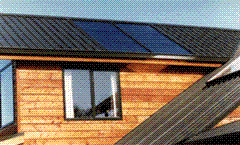 Solar collectors can be incorporated into the roof during construction of the house. |
||
Arthur Williamson
Born in Auckland, raised in Lower Hutt, studying at Victoria University and Canterbury University, working at Otago University and finally at Canterbury University, Arthur Williamson is very much a New Zealand chemist.
Young Arthur spent his teenage years pottering around in a laboratory built in his Dad’s garden shed — not a particularly unusual hobby for a boy in the 1940s. He has fond memories of making up explosive mixtures (from chemicals no schoolboy could purchase today), then packing old shell casings with the mix, going down to the Hutt River to build small dams to be blown up by the salad roll-sized bombs! A year or two later, he was following the instructions in a magazine to have a go at making his own synthetic rubies. Through these experiments he learnt perseverance and the knack of making things work using the equipment available. After studying the sciences at Hutt Valley High School and doing well in the Scholarship exams, Arthur went to Victoria University to study chemistry, but was interested in the practical aspects of chemistry, so transferred to Canterbury University to do a course in industrial chemistry, followed by post-graduate work in physical chemistry. Shortly after starting his PhD, his supervisor went back to England. In the days before email and cheap toll calls Arthur found it very difficult to keep in touch with his teacher — so he packed his bags and went to England. It was a lucky decision, because his supervisor happened to be based at Reading University, which was where the world’s leading thermodynamic scientist was based. He gained a reputation as a ‘can do’ Kiwi, who focussed on what he wanted to achieve, rather than concentrating on how ‘the book’ said things should be done. After completing his PhD, he was invited to California to work with another leading thermodynamics team — and help get their experimental equipment working! By this stage Arthur was married, and the couple wanted to return to New Zealand to raise a family. Arthur accepted a position teaching physical chemistry and thermodynamics at Otago University, and stayed there 7 years before moving back to Canterbury to teach thermodynamics to chemical engineers. He found working in the chemical engineering department gave him more opportunities to apply his knowledge of thermodynamics to real-world problems. Simple changes can often result in dramatic cost savings. For example, instead of using expensive daytime electricity to cool a building, you can make ice in the basement at night with cheap electricity, and cool the building during the day using the ice. Professor Williamson is retired now, though he still has an office at the university. He has great pleasure in meeting ex-students and finding out what they have done with the principles he taught. Of his own achievements, he is most proud of the Thermocell solar water heater, because it was a project he started from scratch that has grown into a successful and uniquely Kiwi company which does over a million dollars of business each year. |
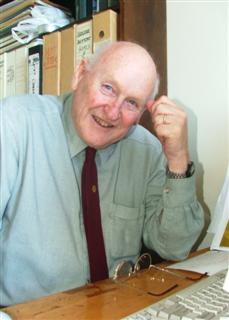 In his many years in chemistry, Arthur has met many world-famous scientists. When this photograph was taken he was recalling the day he had lunch with Linus Pauling in California. |
||
|
|