| More about optically active compounds | |||
|
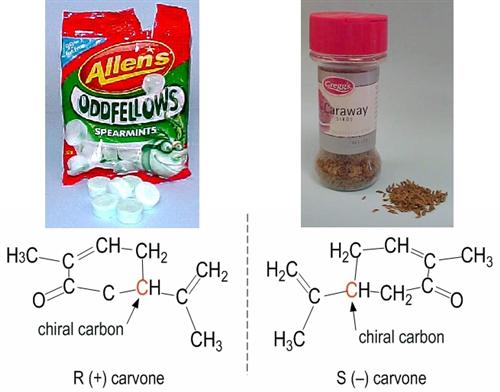
A large number of naturally-occurring compounds are optically active. Many of these compounds affect the human body. Sometimes one enantiomer is biologically active (it affects the body in some way) and the other is inactive, while in other cases both enantiomers are active, but behave in different ways. Spearmint and caraway
Spearmint oil, used to flavour some sweets and toothpastes, contains R
(+) carvone, while caraway oil contains S (–) carvone. They smell differently,
because their different molecular shapes fit into different receptors in
your nose.
Alpha lipoic acid is an antioxidant that increases cellular uptake of glucose
and is thought to have anti-aging properties. It is a common ingredient in
supplements for high-performance athletes, and is sometimes used in the treatment of
diabetics.
Penicillin
The naturally-occurring enantiomer is the R (+) form. The S (–) form is significantly less effective as an antioxidant, it reduces cellular glucose uptake, and has little or no effect in most of the other reactions shown by the R form. Alpha lipoic acid can be purchased at some health food or sports stores. The cheaper option contains a racemic mix of both the R and S forms. The more expensive version contains just the R form. Generally any bottle of ALA that does not specify that it is ‘enantiomerically pure’ will contain a mixture of both isomers.
Alanine is one of the 20 amino acids used in our bodies to make protein.
It is optically active, and our bodies use L-alanine. Most bacteria use D-alanine
though, and the antibiotic penicillin works by combining with D-alanine
to rip open the cell wall and destroy the bacteria. Since we don't use D-alanine,
the antibiotic has no effect on our cells.
Thalidomide
In 1956 a new drug was released on the market. It was a mild sedative,
useful for people having trouble sleeping, or who were anxious or depressed.
It was also offered to pregnant women troubled by morning sickness. Thalidomide
was effective in all these areas, and seemed to have virtually no side effects.
Sales soared.
Meanwhile, in maternity homes around Europe, the birth of deformed babies was also rising. There have always been some babies born with defects, but in the late 1950s far more seem to have been born than usual, many with the same types of defects such as extremely short arms or legs, or arms or legs completely missing. After five years of research, it was finally realised that what these babies had in common was mothers who had taken thalidomide in early pregnancy. Thalidomide is optically active. One enantiomer has the desirable, sedative properties while the other acts as a teratogen — it causes damage to a growing foetus. Up until this time it had not occurred to scientists that a drug that was safe for general use may not be safe for pregnant women. After the thalidomide tragedy, the testing procedures on new drugs were changed. It is now much harder to get a new drug approved for use. |
|||
|
|
|||