|
|
The story of nylon
Small beginnings In 1800 Frenchman Eleuthère Irérée du Pont immigrated to America with his father and older brother — political refugees from the French revolution. E I (as he became known) had been a pupil of Antoine Lavoisier, who was beheaded by the revolutionaries in 1794. Before the revolution, E I had managed a gunpowder factory. American-made gunpowder was poorer in quality to the French product, so E I set up his own gunpowder factory in Delaware in 1802. He called it E I du Pont de Nemours and Company . Today this company is usually just known as DuPont . For the first 100 years the DuPont company made explosives — first gunpowder, and then dynamite. Early in the 20th century though, the company began to diversify into other chemicals, such as the new packaging film Cellophane, and the first synthetic fibre Rayon. Both of these products were invented by scientists from outside the company, but improved by DuPont scientists.
DuPont had always employed scientists and engineers to solve problems in
the manufacturing process or improve products. In 1926 Charles Stine suggested
to the company directors that they set up a new team of scientists whose
job would be to do fundamental research — what today is known as ‘blue sky’
research — that may not have an immediate practical or commercial use. His
theory was that the fundamental research could lead to undreamt of products,
and that DuPont would get a head-start on the manufacture and development
of those products.
Macromolecules
The company agreed, and Stine set out to recruit his scientists. He managed to form a group of enthusiastic young researchers, but struggled to find an experienced scientist to lead them. The difficulty was that university scientists (who do fundamental research) had a low opinion of industry and the top-quality researchers didn’t want to give up their high-status jobs. Eventually, one of them suggested he ask Wallace Carothers — a brilliant organic chemist who was good with people but who preferred research to teaching. Carothers was reluctant, but the promise that he would never have to give another lecture appealed to him, and he agreed.
During the 1920s there was much argument among chemists about the nature
of substances such as rubber, starch and cellulose. Were they single substances,
or mixtures of many substances? What forces held the substance together?
If they were single substances, why was it so difficult to agree on a molecular
formula or molar mass?
Rubber was the most well-known of the problematic substances. During the First World War, supplies of natural rubber to Germany were blocked, so German chemists had attempted to make a synthetic substitute — to keep the tanks and trucks moving. It was agreed that the empirical formula for rubber was C5H8. What was not agreed was whether rubber was composed of a large number of small molecules, held together by some special force peculiar to these substances, or a single, very large molecule, containing ordinary covalent bonds. Most chemists though the second theory was impossible, partly because this very large molecule would be hundreds of times larger than any molecule they’d so far met, and mostly because these ‘molecules’ of rubber seemed to be able to have different molecular formulae. It had been a basic rule of chemistry for over 100 years, that all molecules of the same compound have the same formula. | ||
|
German chemist Hermann Staudinger was a strong advocate for the macromolecule (large molecule) theory, which he had helped develop. In 1926 he showed that rubber was unsaturated (contained double bonds), and he then added hydrogen to rubber and formed an alkane, also with a large molar mass. This experiment didn’t convince all chemists, but it did satisfy Wallace Carothers. He agreed that, as Staudinger insisted, rubber was composed of many small molecules, joined together by covalent bonds. Carothers decided that the way to prove this idea was to try to combine other small molecules into long chains.
| |||
|
Polyester
How could Carothers convince small molecules to join together? They’d need
a ‘hook’ at each end. Alcohols and carboxylic acids join together to make
esters so Carothers decided to try to build ‘polyesters’ by mixing a compound
with an acid group at each end, with a compound with an alcohol group at
each end. It worked! He immediately formed compounds with molar masses between
3000 and 5000, and soon had a process worked out that could produce molar
masses as high as 25 000. These substances were tough, opaque solids which
became transparent, viscous liquids when heated. Threads could be pulled
from the molten mix — threads that, when cool, became strong, elastic fibres.
Was polyester the new money-maker for DuPont? As tensions between America and Japan increased during the 1930s, the supply of silk was becoming tight. There would be a growing demand for a silk substitute. Carothers and his team tested a large number of different polyesters, looking for one that would be suitable for marketing. The threads were strong and elastic, but they disintegrated easily in common solvents, and their melting points were too low. It looked like polyester was a non-starter. |
|
||
|
Nylon
DuPont were keen for research into a silk substitute to continue. The economic
conditions of the early 1930s were such that ‘blue sky’, non-commercial research
was a luxury they could no longer afford. Carothers was told to develop a
new polymer, like polyester, but with a higher melting point.
Carothers knew that amides have higher melting points than esters (remember, almost all amides are solid at room temperature). Amides are also insoluble in most solvents. So in 1934 he told his team to start work on making polyamides. His idea was an immediate success. The new material had a much higher melting point than polyester, was solvent resistant, and yet could also be pulled into a strong, elastic thread. Carothers and his team made a total of 81 different polyamides and tested them. Each was made by combining a diamine with a dibasic acid (a compound with an acid group at each end). The compounds were distinguished by the number of carbon atoms in each of the monomers: polyamide 5,10 was formed from a 5-carbon diamine and a 10-carbon dibasic acid. Carothers felt that polyamide 5,10 had the most desirable combination of properties, but the DuPont management decided to manufacture 6,6 instead, because the monomers for 6,6 could be cheaply made from the raw materials in crude oil, whereas the monomers for 5,10 were much more expensive. They made a small amount of polyamide 6,6, formed it into a fine thread and took it to a factory that made stockings. Would the stuff actually work in a real consumer product? Yes! The stockings it made were even finer and more desirable than silk stockings, and they were more durable as well. Polyamides got the name we know them by today — nylon — in 1938 when the new stockings were put on the market and sold out within hours. When America entered the Second World War, in 1941, DuPont made nylon parachutes, ropes, combat uniforms and components for vehicle tyres. Little nylon was left over for frivolous stockings. Their scarcity simply made them more desirable. After the war nylon stockings, lingerie, shirts, curtains and carpets were made and snapped up by consumers keen to try the modern synthetic fibres. |
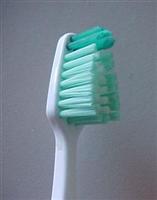
Before nylon, toothbrushes were made of hog's bristles which trapped moisture and quickly became mouldy and smelly. Many people didn't brush their teeth at all.
|
||
|
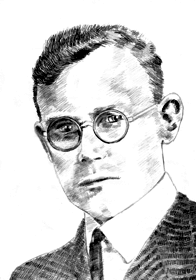
Wallace Carothers (1896–1937)
When Wallace Carothers finished high school he joined his father at the
Capital City Commercial College, studying accounting. Although he was bright
and could do the work, accounting didn’t interest him, so after a year he
transferred to another small college to study science. He paid his way by
teaching accounting courses as he learnt chemistry. In his final year, 1918,
the chemistry teacher left to fight in the First World War, so Carothers
took over teaching the chemistry class as well. After completing his BSc,
Carothers transferred to Illinois University (with an excellent chemistry
department) and gained his Masters and PhD, before accepting the appointment
at Harvard University.
Carothers was very well read and interested in a wide range of topics including art, music, poetry, politics and sport. He was a talented leader of men, able to guide his team to great work. During the 9 years he worked at DuPont, Carothers published 31 papers about polymers — both synthetic and natural — and how they are formed. In recognition of his work, he was the first organic chemist to be elected to the American National Academy of Sciences in 1935. Although Carothers was a great scientist, he was also a person, with a life outside the laboratory. Tragically, despite his many friends and his professional success, Carothers was affected by increasing periods of depression. He took his own life in 1937, which meant he died before the birth of his daughter, and before the world-wide release of nylon. |
|
||
|
|