|
|
Medicinal chemistry Most people assume that if you want to save people’s lives, you should go to medical school. Doctors are the most visible part of the health system, but it is chemists who develop the medicines that do most of the work. A small group of Auckland chemists have developed a compound with the potential to save the lives of, or improve the quality of life for, millions of people world-wide each year. This compound is in the final trial stages now, and looks likely to become a routine treatment for stroke, heart-bypass and head-injury patients by 2010.
When an injury happens to part of the brain — whether from a stroke or
some sort of trauma such as a bullet to the head — some cells die immediately,
but the surrounding cells are also affected and start to die off 8–12 hours
later. It’s as if that part of the brain becomes bruised, but then all the
bruised tissue ends up dead. The long-term affects of the injury could be
significantly reduced if we could find a way to stop the bruised cells from
dying.
Auckland University biochemists discovered a protein produced in the brains of animals with brain injuries. This protein was quickly hydrolysed to form a small tripeptide known as GPE, which appeared to protect the nearby brain cells from death. Unfortunately GPE only delays cell death a short time — the cells still end up dead. The biochemists told their colleagues at the Department of Organic and Medicinal Chemistry about this tripeptide and suggested that it was worth further study. Peptides
Tripeptides are small molecules formed by joining 3 amino acids together.
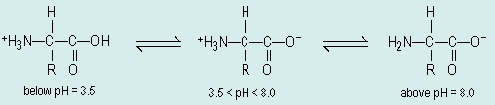
Amino acids contain both an amine group and a carboxyl group, and are therefore
pH sensitive, with the amine group gaining a proton at low pH, and the carboxyl
group donating a proton at high pH:
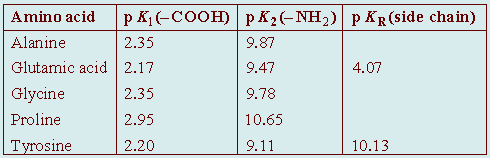
In some amino acids the ‘R’ group is also pH sensitive. There are tables listing the pKa of each pH sensitive group (including the R groups) of amino acids so that people working with them know what form the amino acid will be in at each pH.
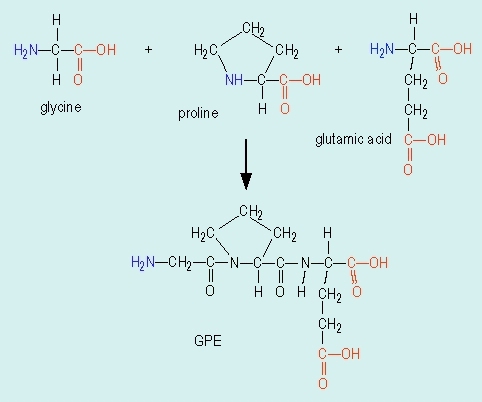
When amino acids join together (forming short groups called polypeptides, or much longer chains called proteins) the amine group of one amino acid joins with the carboxyl group of the next, making a peptide bond. These bonds don’t ionise at different pHs, but can be hydrolised — broken — reforming the amino acids. GPE is formed from the amino acids glycine, proline and glutamic acid:
This tripeptide has 3 pH-sensitive groups, each with its own pKa. What the university chemists needed to do was work out what form GPE is in when it is active in the brain, what parts of the molecule are critical to its effectiveness, and how to ‘tweak’ the molecule (by changing the side chains) so that it will remain in the brain for longer than the naturally-occurring substance. They also needed to make sure the final compound passes through the blood-brain barrier (that prevents most substances in the blood from entering and affecting the brain). If possible, they also wanted a compound that could be taken in pill form without being broken down in the stomach. It was also essential that the compound was safe for people to take! |
|
|
|
Neuren Pharmaceuticals
After initial work on GPE at the university, the research was passed to
a spin-off research group called Neuren Pharmaceuticals Ltd,
which takes compounds discovered by the University of Auckland and develops
them into medicines. Neuren developed GPE into Glypromate® and
are working with researchers in the US (including the US Military, who have
a keen interest in a medicine that will reduce brain damage after head injuries)
to test the compound on patients. There is considerable interest in Glypromate® world-wide,
because at present there is nothing that reduces cell death after brain injuries.
The chances of winning a race are pretty high when you’re the only competitor!
Glypromate® is being tested on heart-bypass patients because up to 70% of bypass patients are affected mentally after their surgery. It’s thought that tiny clots form after the heart is restarted, and that these travel to the brain and cause mini-strokes. Unlike naturally-occurring strokes, or the brain damage caused by accident or war, the bypass surgery is planned, so before and after tests can be done on the patients to see exactly what effect the treatment has. Early results look very promising. Glypromate is just one of the compounds Neuren is working on. Others may develop into treatments for Multiple Sclerosis, Parkinson’s Disease or Alzheimer’s Disease as well as various kinds of cancer. The company’s links with overseas research groups mean that compounds developed in New Zealand are able to be tested in the US and gain the FDA approval which will allow them to be used in most countries in the world. |
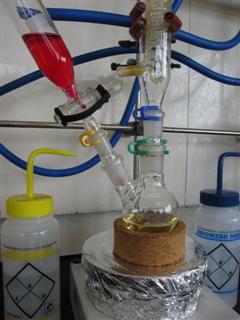
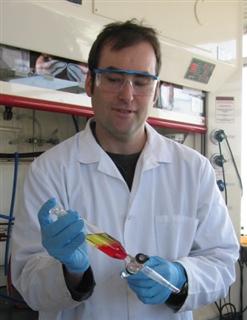
There’s plenty of ‘wet’ chemistry involved in organic synthesis. |
||
| Paul Harris
Neuren scientist Paul Harris came to New Zealand as a baby and has spent most of his life in Auckland. He completed his schooling at a Rudolf Steiner school, which offered a general science course, but no formal training in the specific sciences. On reaching university though, Paul decided to enter for a BSc because he felt that there were likely to be more career opportunities in the sciences than in the arts.
In his first year Paul studied chemistry, biology, mathematics and computer science. He found the first few months very difficult, because everyone else seemed to know work that he had never studied. Why did he persevere? He had the encouragement of his family and the support of several friends from school that had enrolled in the same courses. He took advantage of the support mechanisms provided by the university, and he refused to give up. By the middle of the year he was starting to understand the material. He found that the better he understood the chemistry, the easier it was to learn, and the more interesting it became. At examination time he worked on the biology and maths, but the chemistry seemed to go in with little effort. Organic chemistry appealed most, so he focussed on this for his degree, and carried on to do a Masters in organic synthesis, followed by a PhD also in organic synthesis. After his PhD, Paul spent a year in Paris, working for a pharmaceutical company developing compounds for the treatment of AIDS. This was followed by work in Melbourne for another pharmaceutical company. He enjoyed these opportunities to work overseas, but was pleased when Neuren was established in 2001 and he was able to do the work that he loved while living close to family and friends in Auckland. Paul’s job requires him to find methods to produce hundreds of different compounds, each one free from contamination. Those compounds that look promising then need to be produced in larger amounts – and the methods used to produce large quantities are often different from those that can be used for small amounts. If everything worked the way he expected it to, Paul reckons he’d get bored pretty quickly; but the unexpected happens every day in the lab, so he never knows what the next problem will be. He enjoys meeting each new challenge as well as the satisfaction of helping to develop revolutionary treatments that, if successful, will help millions of people. |
Perhaps this compound will save lives. |
||
| |