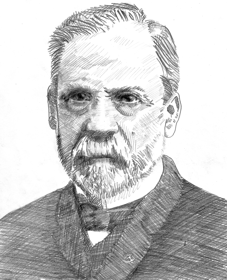
Louis Pasteur 1822–1895 |
|||
|
|
 |
||
The student |
|||
|
Louis Pasteur was born in 1822, in a small town in eastern France, near the border with Switzerland. As a teenager Louis Pasteur was very good at art, got satisfactory marks in maths, and make no effort in any other subject. He was determined to become a (famous) painter and wouldn’t need to be good at anything else. Unfortunately for the world of art, young Louis attended a series of lectures given by the French organic chemist Jean Dumas, and became excited by chemistry. His marks rapidly improved, and when he had finished with secondary school he won admission to a prestigious university in Paris to study chemistry, not art. |
|||
|
A puzzling compound |
|||
Tartaric acid is found in grapes and wine. Like a number of other naturally-occurring substances, solutions of tartaric acid or its compounds rotate plane-polarised light. A similar compound to tartaric acid, known as paratartaric acid, or racemic acid (from the Latin word for grapes) was made in the laboratory. It had an identical formula to tartartic acid and the same chemical properties, but neither the acid nor its compounds rotated plane-polarised light. Pasteur’s first research project after graduation was to study these two acids and work out why these seemingly identical compounds behaved differently in only one property.
Pasteur thought that optical activity was somehow related to the shape of a molecule. It was a good idea, but in 1848 chemists had no idea how atoms joined together to make molecules, let alone how to work out the shapes of molecules. On the other hand, they did know that compounds formed crystals, and that similar compounds formed crystals with similar shapes. A German chemist, Mitscherlich, had stated that the two acids formed crystals of the same shapes, but Pasteur decided to have another look.
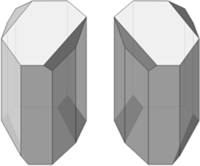
He took formed crystals of a salt of the optically inactive paratartaric acid and used a microscope to study them. He saw that each crystal had a lopsided, asymmetric shape. As he started to sketch them though, his artist’s eye noticed something that Mitscherlich had missed: the sample contained a mixture of two different kinds of crystals, some ‘leaning’ to the left, and some to the right. The two sorts of crystals were mirror images of each other and could not be superimposed. It seemed reasonable to suppose that the two different kinds of crystals would each bend plane-polarised light in a different direction – and that when there was an equal mixture of the two, the sample would be optically inactive.
To test his idea, Pasteur used a needle to separate the sample into left-leaning and right-leaning crystals. Then he dissolved each in water and tested their optical activity. He was right! Each solution rotated plane-polarised light – one clockwise, and the other anticlockwise. |
Pasteur discovered two different kinds of crystals in racemic acid that were mirror images of each other. |
||
|
A scientific breakthrough |
|||
The French physicist, Jean Baptiste Biot, was the leading authority on substances that rotate plane-polarised light. Pasteur contacted him to report his findings. Biot wanted proof, so he supplied optically inactive paratartaric acid and watched while Pasteur prepared the salt, then separated the crystals into their left and right crystals. He asked Pasteur to predict which sample would rotate to the left, and which to the right. Finally, Biot himself prepared the solutions and tested the optical activity. Pasteur’s predictions were found to be true. Later Pasteur wrote:
Then, very visibly affected, the illustrious old man took me by the arm and said:— "My dear child, I have loved science so much throughout my life that this makes my heart throb."This research earned Pasteur his PhD and established him as a scientist of note. The newly-separated isomer of tartaric acid became known as levotartaric acid, because it rotates plane-polarised light to the left. Since ‘racemic acid’ was now known to be a 1:1 mixture of the two isomers, the term ‘racemic’ was used to mean any 1:1 mix of mirror-image isomers that was optically inactive. Pasteur soon had new duties at the university, but he continued working with tartrates. In 1858 he made a very important discovery when mould spores were allowed to grown in ‘racemic acid’: the naturally-occurring tartaric acid fermented and was eventually used up, while the laboratory produced levotartaric acid remained unchanged. So although ordinary test tube reactions were the same for both isomers, nature clearly had a preference for one isomer over the other. Pasteur became convinced that the presence of only one form of an asymmetric compound is indicative of life. |
|||
|
The microbiologist |
|||
In his job at the university Pasteur was encouraged to work with local industry and to put his science to practical use. He was asked to look into the problems wine, beer and vinegar makers were having with fermentation. All too often they ended up with unexpected and unwanted products. Yields of alcohol might suddenly fall, or the wine turn sour, or vinegar turned into lactic acid. The products formed were all different, but the manufacturers all had the same problem – money down the drain!
Pasteur studied the composition of both spoiled and unspoiled wine. He discovered that the spoiled wine contained a number of compounds that could not have been formed simply from the sugars in grape juice, and that many of these compounds formed asymmetric crystals. That suggested they were made by living things. He also noticed that under a microscope he could see little black rods in among the yeast cells in the spoiled wine, but not in the good wine. He suggested that these little rods were living things that spoiled the wine. Over a number of years he was able to identify the various microbes responsible for the different problems in wine, beer and vinegar. Then he invented a method of pasteurising these solutions to kill the undesirable microbes to prevent spoilage.
Pasteur’s later investigations were all to do with microbes. He disproved the theory of spontaneous generation by showing that sterile broth would stay fresh so long as it was not exposed to any dust or contaminated surface. He saved the European silk industry, being threatened by two diseases that were killing the silk worms, by identifying the parasites causing the diseases and insisting that all infected worms be destroyed. Having made the link between microbes and disease, he then encouraged hospitals to sterilise all instruments and dressings. Finally, he worked out how to cause immunity to serious diseases by injection of the dead or weakened disease agent. |
|||
|
France’s greatest scientist |
|||
|
At the age of 15, the boy Louis was certain he would become a portrait painter; by 30 he had made his mark as a chemist, by 40 he was a famous microbiologist, at 51 he was made a member of the French Academy of Medicine and at 59 he received France’s highest civic award when he was made a Grand Cross Holder of the Legion of Honour. 7 years before his death he established the Pasteur Institute to do research into diseases and immunity. This research facility carries on his work today, with world-leading discoveries in the treatment of AIDS and other diseases. You never know where an interest in chemistry will take you!
|
|||
|
|
|||