| |
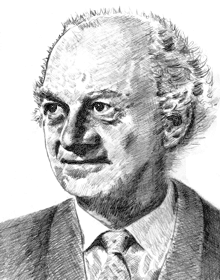
Linus Carl Pauling (1901-1994)
The 18 year old lecturer Linus Pauling was born in Portland, Oregon (USA) in 1901, the oldest of three children. His father died when Linus was just 9 years old, and his mother made ends meet by running a boarding house. Linus was introduced to chemistry by a school friend with a chemistry set. He enjoyed doing experiments, and did well at school, so he decided to train as a chemical engineer. In 1917, Linus entered Oregon Agricultural College (OAC) — the leading university for sciences in Oregon. Two years later his mother wanted him to leave university and get a job to help support the family. The College heard of this and offered him a position teaching the course in quantitative analysis he had completed the previous year. He was just 18 years old. After a year on the staff, he returned as a student to complete his degree. During his year of teaching, Pauling read a paper by Lewis and Langmuir concerning chemical bonds. They suggested that atoms form bonds by sharing pairs of electrons to reach a total of 8 electrons in the valence shell of each atom. This theory started to explain why atoms in the same group of the periodic table form compounds with similar formulae. But only a few years after this theory was published, it was already known to be flawed because it applied to atoms whose electrons orbit the nucleus like planets around the Sun, and physicists had proved that such orbits are not stable for particles with electrical charges such as electrons. Pauling decided that he wanted to find out more about the way atoms work and why they combine in the ways they do. Ernest Rutherford famously said once that ‘all of science is either physics or stamp collecting’. In the early 20th century chemistry was very much in the ‘stamp collecting’ phase, with chemists being expected to remember the preparation, properties and reactions of large numbers of compounds, without much idea of why compounds behave the way they do. If Pauling wanted to explain the chemistry, he would need to study physics. Is it chemistry or physics? After graduating from OAC in 1922, Pauling went to California where he worked for his PhD in physical chemistry and mathematical physics. Much of his time was spent using x-ray diffraction to determine the structures of crystals. This work involved hundreds of complex calculations (all done without computers or calculators) to deduce the positions of atoms in the crystal from the patterns made when those atoms scatter x-rays. In 1925, PhD in hand, Pauling went to Germany to work with physicists who had developed a new model for the atom. They used mathematical equations to explain how negatively-charged electrons could exist in stable orbits around the nucleus. Their model accounted for the coloured spectra emitted by excited atoms, and it showed how two hydrogen atoms could combine to form a molecule of H2. The methods used became known as quantum mechanics, and Pauling quickly mastered it. Pauling spent the next 12 years using quantum mechanics to explain patterns in chemistry. Unlike the others skilled in the mathematics involved, Pauling was a chemist. He was able to greatly reduce the numbers of calculation necessary, because he was trying to explain observed structures. Any theoretical answer that didn't match reality could be discarded. One of the first questions Pauling worked on was that of why carbon forms four bonds. Although carbon has four electrons in its valence shell, two are paired in the 2s orbital, which suggests that only the two 2p electrons should be available for bonding. Since 4 electrons are available, somehow those s and p orbitals must combine to make new, bonding orbitals. Even Pauling, with his great mathematical skill, insight and determination, took several years to find the mathematical solution that would satisfy the rules of quantum mechanics and the reality known to chemists. But eventually he found a way to combine the 2s and 2p orbital into four sp3 hybrid orbitals which are arranged tetrahedrally. As soon as he found the solution for carbon, he was able to apply it to all sorts of other compounds and complexes, showing how different atomic orbitals combine to make hybrid orbitals whose calculated shapes and bond strengths matched the values in data books. Electronegativity and bonding In 1933 he used the concept of electronegativity to bring together the principles of ionic and covalent bonding. He calculated the attraction each atom had for bonding electrons and showed how it could predict the type of bond formed by pairs of atoms. This idea was immediately accepted by chemists who found quantum mechanics too theoretical and mathematical to follow. Electronegativity made sense, and it was useful because it meant chemists could predict the properties of compounds instead of learning them. Throughout the 30s Pauling used quantum mechanics to refine his understanding of chemical bonding. He travelled to many universities in the US and Europe, sharing his ideas in hundreds of papers and lectures. Recognising that most people could not follow the calculations, Pauling was careful to explain his ideas with drawings and plain language that could be understood by the non-physicist. In 1939, when he finally published his material in a book, The nature of the chemical bond , it became a best-seller. It was this work that won him the Nobel Prize in 1954. Later years As a chemist who understood physics, Pauling was invited to work on the atomic bomb project, but he refused, saying that he was a pacifist. After completing his work on bonding, Pauling returned to x-ray crystallography, using it to investigate the structures of complex molecules such as haemoglobin and DNA. This work helped him to recognise the damage that can be done to living organisms by mutations caused by radioactivity. He became increasingly concerned with the build-up of radioactive substances in the environment caused by above-ground testing of nuclear devices in the 40s and 50s, and campaigned to have the tests stopped. In 1963, on the day the Partial Test Ban Treaty was signed by the American and Soviet presidents, the Nobel committee awarded Pauling the Nobel Peace Prize. In his later years Pauling became involved in many issues of public concern. He investigated the growing smog problem in Los Angeles and showed that it was due mainly to cars, rather than factories. He also believed people could prevent colds and other illnesses by taking large doses of vitamin C. Pauling expected to succeed in everything he attempted. This attitude helped him to persevere when others may have given up, but he was not always right. Some of the ideas he forcefully promoted — such as those on vitamin C — are discredited today. But then, Pauling predicted as much in an address to students after receiving his first Nobel Prize: When any old and distinguished person speaks to you, listen to him carefully and with respect — but do not believe him. Never put your trust in anything but your own intellect. Your elders, no matter whether he has grey hair or has lost his hair, no matter whether he is a Nobel Laureate — may be wrong. The world progresses, year by year, country by country, as the numbers of the younger generation find out what was wrong among the things that their elders said. So you must always be sceptical — always think for yourself. Linus Pauling died in 1994, America's best-known chemist and the only man to have won two individual Nobel prizes. |
||
|
|