|
|
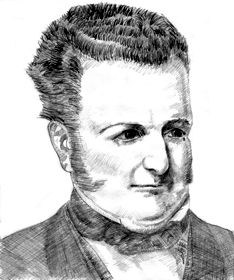
John Frederic Daniell (1790-1845)
Early years
John Daniell was born in London, England in 1790, the son of a prosperous
lawyer. He was well-educated at private schools and at Oxford University,
showing a talent for science and technology.
His first job was working in a relative's sugar refinery, where he was able to make a number of technological improvements to the refining process. Research interested him much more than sugar though. He left the refinery and started doing independent investigations, which he then shared with other scientists. These were so impressive that in 1814, when Daniell was just 24, he was elected as a Fellow of the Royal Society - quite an honour for a young man. In 1817 John Daniell married and went to work in Edinburgh with a newly-formed company developing gas street lighting. He developed a method of making useful gas from resin and turpentine. He also toured France and Germany, promoting the use of gas lighting in those countries. At the same time as he was working for the gas company, he also became professor of physics at Edinburgh University. Not that he stuck to physics though -- he also investigated many aspects of meteorology and taught classes in chemistry. By 1823 he had published a popular book about the weather as well as inventing an instrument to measure humidity and another instrument to measure very high temperatures. He also discovered the importance of humidity control in greenhouses - which would have been in common use in Edinburgh. The battery at the Royal Institution Daniell's reputation as a practical scientist was well-established when he returned to London in 1831 to become Professor of chemistry and meteorology at the new King's College of London. He became close friends with another scientist with a growing reputation - Michael Faraday - whose laboratory at the Royal Institution was just a few kilometres from King's College. Faraday and his predecessor Humphrey Davy had done many experiments using electricity generated with batteries composed of many zinc and copper (or silver) discs, separated by paper or cloth soaked in acid or some other electrolyte (conducting solution). The first battery, called a Voltaic pile, had been constructed by Alessandro Volta in 1800, and only minor improvements had been made since then. The battery at the Royal Institution was huge - capable of producing high currents and voltages. Daniell must have been fascinated as his friend demonstrated some of the unusual properties of electricity and how it could be used to discover new elements. Unfortunately the battery would stop delivering current after less than an hour - even though none of the chemicals were used up. To get it working again the whole thing needed to be pulled apart, cleaned, and put back together again. In 30 years of electrical experiments, no scientist had managed to make a battery that would last. The Daniell cell
In 1835 Daniell started to study the battery in detail. He discovered that as current flows through the electrolyte, bubbles of hydrogen gas (formed due to electrolysis of water) coat the copper electrode. As the surface area of exposed copper becomes smaller, the current output drops. Daniell solved this problem by building two half-cells. He began with a container made of copper metal, into which he put an unglazed clay pipe. Around the outside of the pipe he poured saturated copper sulfate solution, while inside it he added dilute sulfuric acid and the zinc electrode. As current flowed, the zinc electrode slowly dissolved to form Zn 2+ (aq) inside the pipe. Cu(s) also formed on the copper container. Some solid copper also formed on the outside of the clay pipe, and eventually this pipe became blocked and needed to be replaced - but that process took months of continuous operation. Daniell's cell was an immediate success. It took electricity out of the basements of research laboratories such as Faraday's, and put it on the benches of anyone who wanted to use it. The Royal Society awarded him the Copley medal - its highest award - in 1837 for the invention of the Daniell cell. Daniell remained at King's College until his sudden death from a heart attack at a meeting of the Royal Society in 1845. If he had lived a few years longer, he would have seen thousands of his cells being used to power the telegraph system that allowed virtually instant communication across America, and later, around the world. |
||
|
|