
|
|
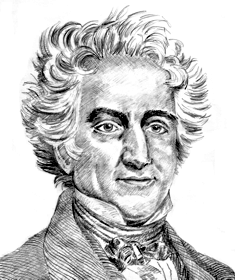
Michel Eugène Chevreul
 From hair gel to tablet soap
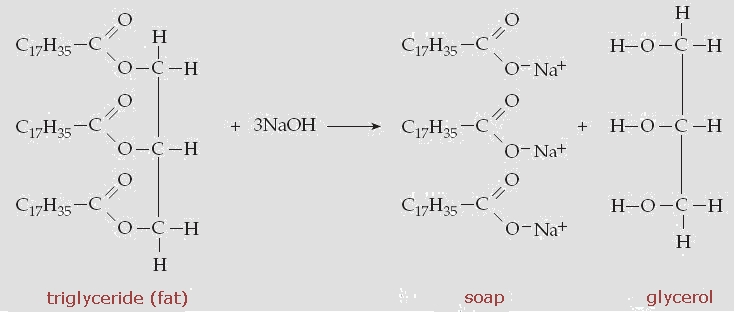
When fat is heated with water and an alkali such as potassium or sodium
hydroxide, a jelly-like mixture of soap and glycerol is formed, in a process
called saponification. This reaction has been done for at least 4000 years. At
first, the product formed was used as a hair gel, but soap became used for
cleaning from about 1800 years ago.
Around 500 years ago, soap-makers discovered how to make a hard soap, by first using sodium hydroxide with the fat, and then by adding salty water to the saponified mixture. This causes the solid soap to float on the surface, while the glycerol remains dissolved in the water. No-one knew why this process worked, but the solid form of soap was convenient to use. French chemist, Michel Chevreul turned the craft of soap-making into a science when he began a 10-year investigation into fats and soaps in 1813. The discovery of fatty acids
Chevreul’s first discovery was made when he added acid to a mixture of
soap and water and saw a insoluble solid float to the top. This fat-like
substance had acidic properties, so he called it a fatty acid. When
he attempted to purify this solid he discovered that it was composed of two
different acids which were named stearic acid and palmitic acid. He also
discovered a third acid, liquid at room temperature, which he named oleic
acid.
These same three acids could be formed from the soaps made from fats of
many different kinds of animals, but each fat produced the acids in different
proportions. This suggested that the fats had a common structure.
The science of saponification
Next, Chevreul looked more closely at the saponification reaction. He learnt
that during saponification, water enters the fat molecule, splitting it into
fatty acids and a sweet, soluble substance he named glycerine (from
the Greek word glukeros, meaning sweet). He was unable to determine the structure
of this substance, but today its formal name is propan-1, 2, 3-triol, more
commonly known as glycerol (because of the alcohol groups), but also still
called glycerine. When base is present, the fatty acids react to form the
salts known as soap.
RCOOH + NaOH Butter-acid
Chevreul also investigated the fats found in cow and goats milk. Soaps
made from these fats formed some short-chained fatty acids with strong smells.
He called the acid from butter butyric acid — today called butanoic acid.
It has 4 carbons, which is probably why the prefix but — is used for all 4-carbon
chains (eg butane, buanone). Butanoic acid gives vomit its characteristic
odour. Its smell can be removed by adding baking soda:
CH3CH2CH2COOH
+ NaHCO3 A better candle
By 1823 Chevreul had completed his investigations into fat and soap, so
he turned his attention to a related use of fat — candles. At that time,
candles were made either from tallow — animal fat — or beeswax. The beeswax
candles were clean-burning and sweet-smelling, but they were very expensive.
The common people had to make do with tallow candles, which smoked, had an
unpleasant smell, and softened on hot days. Chevreul discovered that he could
make a much better candle out of solid fatty acids. His candle was hard even
in the heat of summer, and it burnt without smoke or odour. It took a while
for a method of producing fatty acid candles on a large scale was perfected,
but once it was, the days of smoky tallow candles were gone forever.
His work on fatty acid candles lead the French government to award Chevreul a prize for the encouragement of national industry in 1852, and the Grand Medal of Honour in 1855. Michel Eugène Chevreul (1786-1889)
Michel Chevreul was born in France 1786, and though he won international
fame, never left his homeland. His childhood was overshadowed by the violence
of the French Revolution. Schools were closed during this time, so he was
educated at home. Since his father and grandfather were well-educated doctors,
this enforced ‘home-schooling’ may well have given him a head start, especially
in the sciences. Whatever the reason, when schools reopened, young Michel
quickly reached the top of his classes in most subjects. When he went to
university though, he turned away from the family business of medicine, and
chose to study chemistry instead. His teachers were pupils of the great Antoine
Lavoisier, who was beheaded in the early years of the revolution, but not
before establishing some of the fundamental principles of chemistry.
After completing his studies, Chevreul became a dedicated research chemist. After completing his work on fats, Chevreul wrote a paper about general organic investigations. Among the principles he laid out was that of determining the purity of a substance by measuring its melting point. Pure substances have a single, sharp melting point, while mixtures melt across a range of temperatures. He also emphasised the importance of making many observations from different but related reactions before working out the theories to explain them. The great Swedish chemist Berzelius (1779-1848) praised Chevreul’s study of fats and said that it was ‘the most complete and best executed series of experiments yet found in all of chemistry’ and that ‘Chevreul’s work ought to serve as a model for young scientists who wished to do research in any field of chemistry.’ German chemist Liebig claimed that ‘this work was the basis of all prevailing methods of analysis and investigations of organic materials.’ Chevreul’s other main contribution to chemistry was in the field of dyes and colour. As with fats, he performed hundreds — perhaps thousands - of experiments over many years, investigating everything from the characteristics of the fibres being dyed, to the nature of the colouring agents, and the effects dye purity, water purity, temperature, air, sunlight and bleach have on the final colours. He also investigated the way the appearance of a coloured yarn alters when it sits beside other yarns of a different colour. Chevreul was a gifted chemist, but he also worked very long hours, spending 6 days a week in his laboratory. He never retired, but continued to work hard, right up until his death at the age of 103. It wasn’t all lab work though. Chevreul gave many lectures and was appointed Professor of chemistry at the Muséum, wrote several chemistry texts, was made director of dyeing at France’s national tapestry works at Gobelins and served as President of both the Académie des Sciences and the Societé Royale de Agriculture . His fat research greatly improved French soap and candle-making, while his work on dyes and colour revolutionised the French tapestry and carpet industries and led to a new style of painting called neoimpressionism. In return, France honoured him with several prizes and medals, and he received many honours from other countries. In 1886 his 100th birthday was celebrated by a gathering hosted by the President of France and scientific delegations from all over the world. In his long life, Chevreul accumulated an impressive list of awards and titles. Normally, these titles would be written after the name on academic publications (eg M Chevreul, Member of the Académie des Sciences). But as he got older, Chevreul stopped listing these titles and simply put himself down as ‘M Chevreul, senior of the students of France’. No matter how much he accomplished, Chevreul never wanted to stop learning. |
||
 R-COO–Na + + H2O