| |
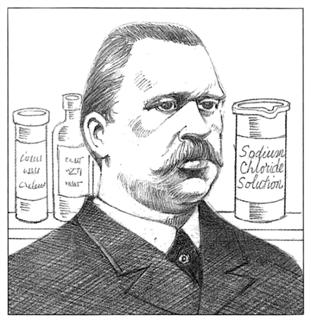
Svante Arrhenius 1859-1927
Svante Arrhenius was born in the Swedish city of Uppsala in 1859. He was a brilliant student, graduating from high-school top of his class. He studied physics, mathematics and chemistry, first at Uppsala and then at Stockholm universities.
A study of solutions
For his PhD, Arrhenius studied what happens when substances dissolve in water.
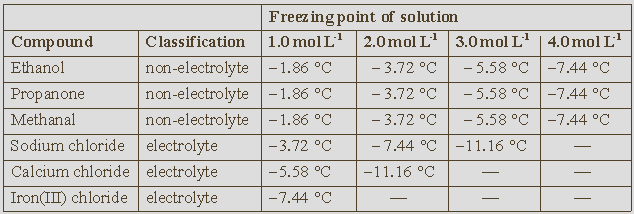
In the early 1830s Michael Faraday had identified substances as either electrolytes or non-electrolytes according to whether their solutions conduct, or do not conduct electricity. Faraday also recognised that there must be some sort of charge carrier in electrolyte solutions. He called these charge carriers 'ions' and he assumed that they were somehow produced when the electric current flowed through the solution. Arrhenius also knew that although pure water freezes at 0 °C, its freezing point is lowered when anything is dissolved in it. Electrolytes seemed to have a greater effect than non-electrolytes. When the concentration of each solution is given in mol L -1 , a pattern starts to emerge. All the non-electrolytes behave the same, regardless of the compound being dissolved. Freezing point depression in non-electrolytes seems to depend only on the number of particles being dissolved, not on the size of those particles. However, the freezing point of electrolytes is the same as non-electrolyte solutions of much greater concentration. For example, sodium chloride solutions act like non-electrolyte solutions of double their concentration. It was as if the sodium chloride 'molecules' were breaking into two pieces when they dissolved in water, with calcium chloride breaking into three pieces and iron(III) chloride breaking into four pieces. Preposterous though this idea seemed, it kind of made sense, when you consider the formula of each compound: NaCl, CaCl2 and FeCl3 . Somehow all those atoms just flew apart when the compound went into water. And the more atoms in the compound, the more bits it broke into.
The problem was, sodium atoms and chlorine atoms are very different from sodium chloride. You can't smell chlorine gas when salt dissolves in water, nor does sodium metal form. Well, no, said Arrhenius. That's because the broken bits of compounds aren't atoms — they're ions. Ions have different properties from atoms, they have charges which allow electrolytes to conduct electricity and they're formed when you add water to electrolytes, not when electricity passes through the solution. A fourth class degree
Arrhenius wrote up his ideas for his PhD thesis in 1884. To chemists today his work is so completely integrated into our understanding of solutions that we don't even think about it. But in 1884, 13 years before the discovery of the electron, matters were very different. His professors believed that atoms were indivisible, so where did the charges on Arrhenius's 'ions' come from? And why was it that the chloride ion had properties so very different from a chlorine atom? And since sodium chloride was known to be a particularly stable compound, how was it that something as mild as water could cause the compound to fly apart to form these new particles?
Arrhenius's professors were not convinced by his theory, so although they accepted that he'd worked hard, they award him only a fourth class degree — the lowest grade possible. The struggle for acceptance
Undaunted, Arrhenius sent copies of his thesis to a number of scientists across Europe who were studying solutions. One of them, Wilhelm Ostwald, was so impressed he travelled to Sweden to meet the author and invited him to join his research team in Russia. When Arrhenius refused this offer (because his father was ill and he wanted to stay in Sweden) Ostwald helped him obtain a teaching position in Stockholm, where he quickly gained the respect of his colleagues. Dutch physical chemist Van't Hoff also saw the merit in Arrhenius's theory, and the three scientists shared many ideas over the next decade.
In the late 1890s ideas about atomic structure began to change when Becquerel discovered radioactivity in 1895, and Thomson proved the existence of electrons in 1897. It became obvious that a negative ion was an atom that had gained an electron, while a positive ion was an atom that had lost an electron. At last ideas about atomic structure had caught up with Arrhenius and his theory made sense. Arrhenius received many international honours for his theory, including a Nobel prize in 1903 — awarded by the Swedish Nobel Institute! In 1905, a special position was created for him as Director of the Nobel Institute for Physical Chemistry in Stockholm. Other research
Arrhenius also studied the rate of chemical reactions. He proposed a theory of activation energy — that is, that molecules do not always react when they collide, but that they require a certain amount of energy (different for each reaction) before they will react. This theory, published in 1889, is still accepted today.
After his appointment to the Nobel Institute, Arrhenius widened his research into new areas of study. He did pioneering work in immunology, studied the physics of the Northern Lights ( aurora borealis ), proposed a theory about how life may have arrived on Earth, and considered the issue of climate change. He calculated that carbon dioxide may act as a 'greenhouse' gas, causing the temperature on Earth to be higher than it would otherwise be. His work was more or less ignored for about 75 years, but today carbon dioxide's effects on the climate of the Earth is a serious issue. Svante Arrhenius was a brilliant theoretician whose ideas were frequently not understood by his peers. He endured years of rejection, but persevered until his ideas were finally accepted. Although he could have found work and honour abroad, he remained loyal to Sweden and turned down all offers of positions at foreign institutions. In his later years, he was in much demand as a lecturer throughout the world. He died in 1927 at the age of 68. |
||
|
|