
|
|
Building bones The problem
Natural bone is predominantly made of a porous matrix of calcium and phosphate ions which are deposited around long protein fibres (collagen). The calcium phosphate gives bone its rigidity, while the collagen provides strength and
elasticity. The bone is constantly being maintained by bone cells which break down worn parts and rebuild them, depositing or withdrawing calcium in blood as required. This maintenance process allows broken bones to heal, provided the broken pieces are held in their correct positions and supported while healing. However, the body cannot replace bone lost through injury or illness.
For many years surgeons have replaced missing bone with chunks of titanium, which are strong, relatively light-weight and tolerated by the body. Although the patient is able to use the bone again, they can still feel the foreign material because metal doesn’t flex like natural bone. Titanium hip joints usually need replacing after about 10 years because they wear away the surface of the bone and cause further damage. |
||
|
Artificial bone
Many research groups around the world are trying to develop artificial
bone implants with properties similar to natural bone. Most of these groups
are taking particles of ionic compounds such as calcium phosphate and compressing
them to form ceramics containing pores of about the same size as natural
bone. In theory, bone cells will accept these implants, moving through the
material and carrying out the same repair and replacement processes that
occur in natural bone. After a few months the implant will have been completely
absorbed and there will be no sign of the injury.
That’s the goal, but compressed bone implants seldom work as hoped. MacDiarmid Institute research chemist Kate McGrath has found that the electrostatic environment within each of the holes in bone is important. Because bone contains both ionic calcium phosphate and molecular protein, there are different kinds of intermolecular forces within bone: the electrostatic forces between ions, van der Waals’ forces and hydrogen bonding within the protein molecules. Unless the artificial bone implants mimic this combination of forces convincingly, the implant is not accepted by the body. Kate uses a combination of sophisticated machines at the MacDiarmid Institute to study the intermolecular forces in substances like bone and sea shells. She is developing ways to grow biominerals with the same structure and intermolecular forces as the natural materials. In the future this work could lead to bone implants that really do get changed into natural bone in a few months, artificial hips that don’t need replacing, and decayed teeth that are not simply drilled and filled, but repaired with new dentine and enamel. |
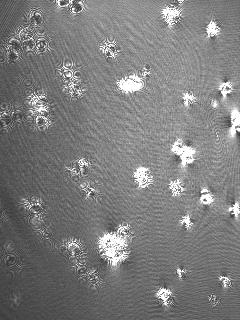
Microscopic crystals of calcite (CaCO3)growing on an artificial cell membrane. Kate studies the way the crystals grow as she varies the conditions of the solution or the membrane. |
||
|
Kate McGrath
Kate’s best subject in Year 11 and 12 was accounting, but she dropped it
after 2 years because it wasn’t challenging enough. In Year 12 she wanted
to become a pilot, so she decided to join the airforce. That meant taking chemistry, physics and maths, all of which
she discovered she enjoyed. When her asthma barred her from joining the airforce,
she decided to become a soil engineer and feed the world. She enrolled at
Canterbury University and started doing Engineering Intermediate — which
is more chemistry, physics and maths. Within a few months she had changed
her mind about engineering because she was enjoying chemistry so much. Kate
carried on taking as much chemistry, physics and maths as she could, doing
Honours Chemistry at Canterbury, and a PhD in chemical physics at an Australian
university, followed by further research in Paris and Princeton (USA). She
may not have been in the air force, but her chemistry allowed her to see
the world! Upon her return to New Zealand in 1997 Kate started working at
Otago University and was one of the founder members of the MacDiarmid Institute
there. For the last few years she has been lecturing at Victoria University
and working with the soft materials group at the MacDiarmid institute in
Wellington.
Kate is enthusiastic about her work and enjoys the mental challenge of trying to find out things that no-one else knows. She’s also keen to share what she has learnt and believes that it is important that people are educated about science. As a teenager she kept changing her mind about what she wanted to do, but for now the combination of research and teaching seems to be just about perfect. |
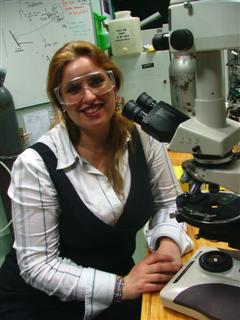
Optical microscopes like this one are useful for some crystal work. For more detailed study of materials Kate uses an electron microscope. |
||