
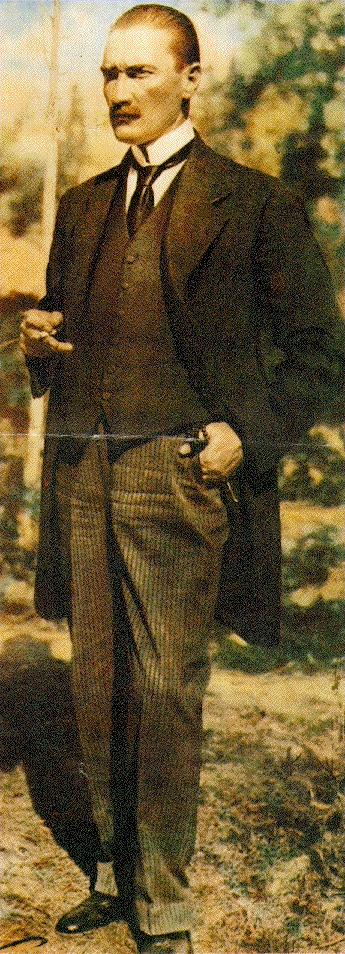
"There are two Mustafa Kemals. One, the flesh and blood Mustafa Kemal who now stands before you and who will pass away. The other is you, all of you here, who will go to the far corners of our land to spread the ideals which must be defended, with your lives if necessary. I stand for the nation's dreams, and my life's work is to make them come true." (Mustafa Kemal Ataturk.)
| 1. Born in 1881 (probably in spring, but this is uncertain), in Salonica, then a Turkish Ottoman city, but now in Greece. | ||
| 2. Father died when he was very young and he and his sister were raised by his mother. | ||
| 3. After primary school he went to a military high school. His mathematics teacher gave him the second name of Kemal (which means perfection), in recognition of his very clever abilities. At that time very few Turkish people had a second, or surname name. | ||
| 4. In 1905 he left military school and was sent to Damascus, then also part of Turkey, but now in Syria. He decided to form a group to get rid of the unpopular Sultan of Turkey. He fought a lot of wars and battles in different parts of the Turkish Empire during the next ten years. He was noticed for his great ability as a military leader. | ||
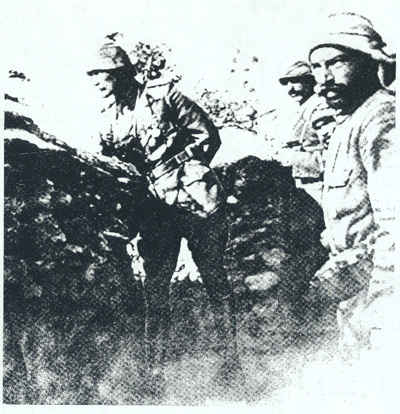
| 5. In 1915 when the Dardanelles campaign started he was a major reason the allies of Britain, France, Australia and New Zealand lost. Although still only a Colonel and not in full charge of the Turkish Army, by his great cleverness and bravery he was able to give very strong military leadership to defeat the invaders. He became a national hero at this time. Had he not been there, quite possibly Turkey would have been beaten. | ||
 |
||
| 6. In 1916 he was promoted to General and he went and fought the British in other parts of the Turkish Empire for the next 2 years. He never lost a military battle. | ||
|
7. In 1919 he began the Turkish War of Independence. In 1920 the Grand National Assembly was inaugurated with Mustafa Kemal as its first President. He continued to fight the War of Independence for the next 2 years. The War of Independence was finally won in August 1922. |
||
|
8. On 29 October 1923 the Turkish Republic was proclaimed with Mustafa Kemal as its President. Ankara was declared the new national capital. |
||
| 9. Mustafa Kemal married Latife Usakligil in 1923. The marriage ended in divorce in 1925. | ||
|
10. During his 15 years as President of Turkey he was responsible for extraordinary modernisation of Turkey. This included: A new political and legal system, abolished the Caliphate, made both government and education secular (free from religious control), gave equal rights to women, changed the alphabet from the Arabic one to the western style, and greatly improved arts, science, agriculture and industry. |
||
| 11. In 1934, when the new law for having a surname was adopted, the National Parliament gave him the title "Ataturk", meaning Father of the Turks. | ||
| 12. In 1938, following an illness of a few months, he died on 10 November. | ||
| 1. He graduated from the Istanbul Army Academy in 1905 with the rank of Staff Captain. | ||
| 2. He was sent to Damascus, which is now in Syria, but then was part of the Turkish Empire. He and some other officers started a secret group to fight against the Sultan, whom they thought was very bad for Turkey. They called him a "despot", which means someone who acts as a tyrant. | ||
| 3. A very brave and clever soldier, he got a lot of attention and promotion in the Army. He was sent to a number of different places in the Ottoman Empire, fighting many different battles. Places he served in included Albania, Tripoli, Salonica, Constantinople and Sofia. | ||
| 4. He was a Colonel when the war began and was placed under the command of the German leader of the Turkish forces, General Liman von Sanders. | ||
|
5. After the Dardanelles campaign he was promoted to General in 1916, at the young age of 35. He then went and carried on fighting for another 2 years in other parts of eastern Turkey. 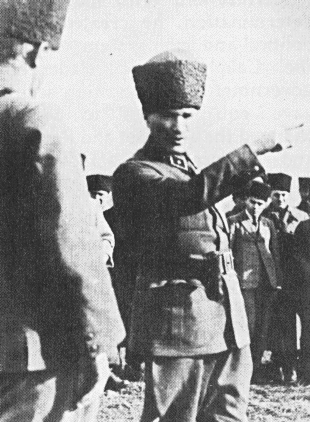 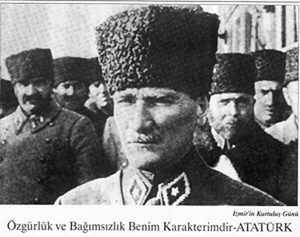 |
||
| 6. In May 1919 he went to the Black Sea port of Samsun to begin the War of Independence. By now he had been given the title "Pasha" to add to his name. He defied the orders of the Sultan and rallied a liberation army in Anatolia. He also set up a conference which created the basis for a national effort under his leadership. | ||
| 7. On April 23 1920 the Grand National Assembly was inaugurated and Mustafa Kemal Pasha was elected as President. | ||
| 8. In August 1922, under his leadership, the Turkish Army finally defeated all the invaders and rebels. The Ottoman forces were totally defeated. | ||
| 1. In July 1923 the Turkish Government signed the Lausanne Treaty with many countries. In October 1923 Ankara became the capital of Turkey and the Turkish Republic was proclaimed. | ||
| 2. He married Latife Usakligil early in 1923. The marriage ended in divorce in 1925. | ||
|
3. On October 29 1923 Mustafa Kemal Pasha was unanimously elected President of the Republic of Turkey. 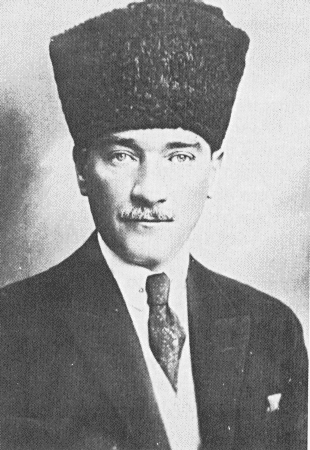 |
||
| 4. Between 1926 and 1930 he introduced many reforms of the Turkish legal system. Religious laws were abandoned and laws set by Government were introduced. The system made all citizens equal before the law, giving Turkey a foundation for a society of justice and equal rights. | ||
|
5. Social reforms were carried on constantly. He said, " The new Turkish state is a state of the people for the people". "We are a nation without classes or special privileges", and " The true owner and master of Turkey is the peasant who is the real producer". Changes included: European hats for the Turkish fez, women no longer wearing the veil, all citizens took surnames, and the Western calendar replaced the Islamic one. |
||
| 6. In 1928 Mustafa Kemal Pasha decided that Turkey should no longer use the Arabic writing script, which it had for a thousand years. It was very difficult to use with the Turkish language. Instead it should use the Latin alphabet, as used in western countries. People thought it might take about 5 years. He said Turkey would do it in 5 months. | ||
|
7. He said, "The Government's most creative and significant duty is education". Schooling was made free, secular (which means "not controlled by any religions"), and co-educational (for boys and girls). If you are good at mathematics and have sharp eyes you might notice something interesting about the sum on the blackboard in the picture. See if you can spot what it is, compared to how we would do it in New Zealand. 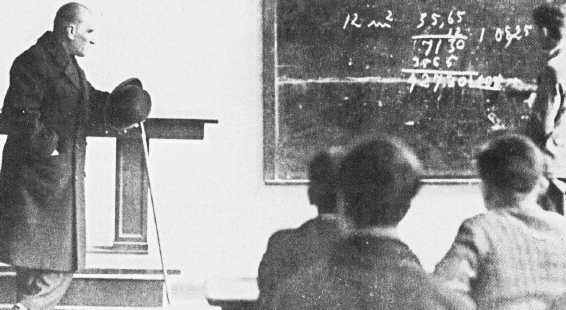 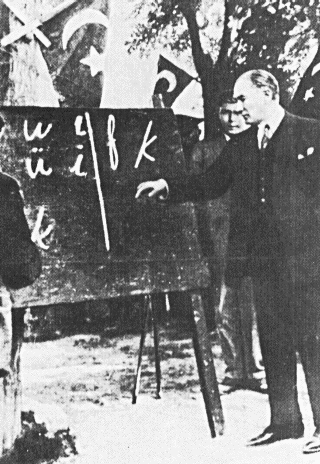 |
||
|
8. In 1934, the National Parliament gave him the title of "Ataturk", meaning, "Father of the Turks". 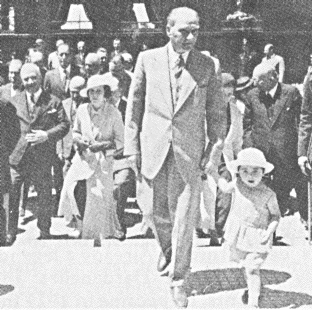 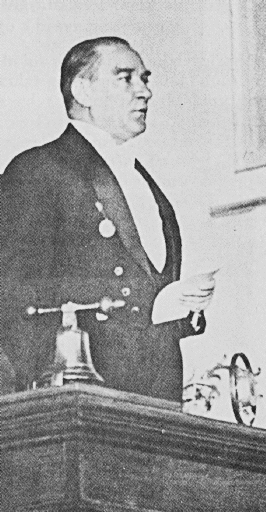 |
||
| 9. He died 10 November 1938, following a short illness. | ||
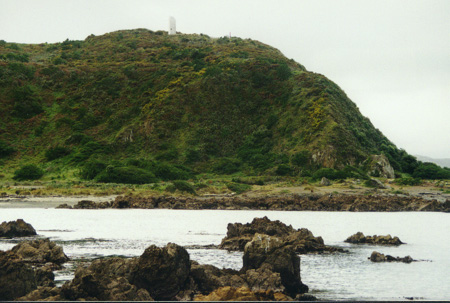 The "Ataturk Memorial" is placed on the hills at the entrance to Wellington Harbour, right at the very southern tip of the North Island of New Zealand. |
||
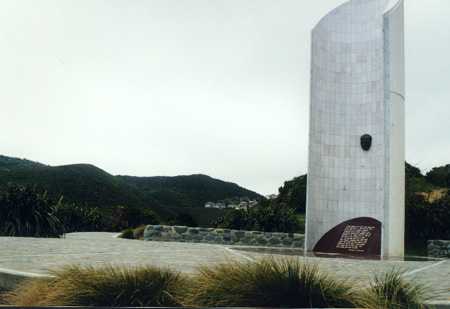 The Memorial has a small bust of the head of Mustafa Kemal Ataturk placed in the centre. |
||
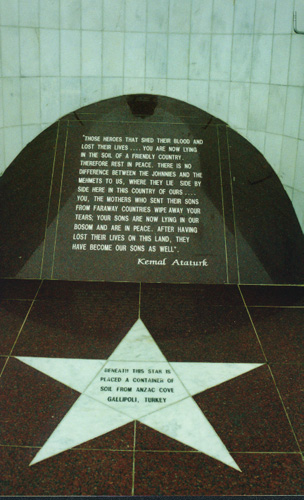 The wonderful words from the Turkish Memorial on Ari Burnu Point at Gallipoli are also recorded here, along with a container of soil from Anzac Cove. |
||
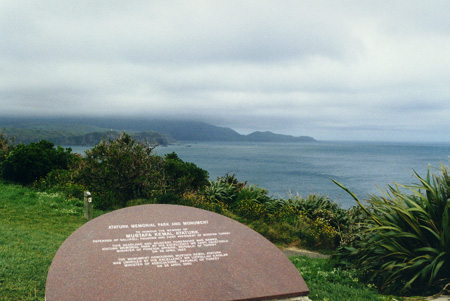 The view looking south, across Wellington Heads, a view not dissimilar to the view looking south towards Gaba Tepe at Gallipoli. |
||