
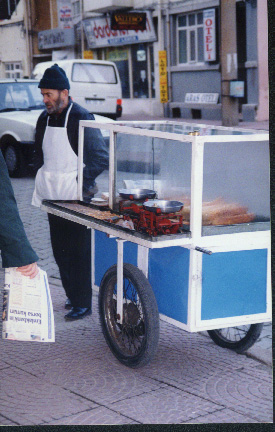
 This man is selling fresh warm bread rolls. He has a set of scales on the side of his cart to weigh the bread to work out how much to charge for it. |
||
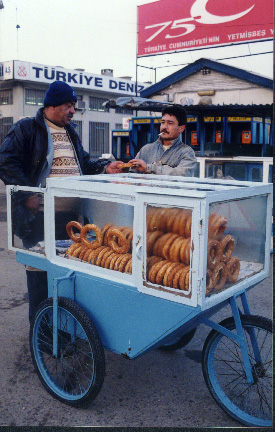 This man is selling freshly baked bread in the morning. It tasted a little like a bun, but it had no icing or sweetness to it. There were small nuts on the outside. I enjoyed eating it, even though I didn't have a drink with it. It was very cheap, so I had two or three for breakfast one morning. Notice the sign behind the men. Signs and flags like this were everywhere, celebrating 75 years of the Turkish Republic since it was founded by Mustafa Kemal Ataturk. |
||
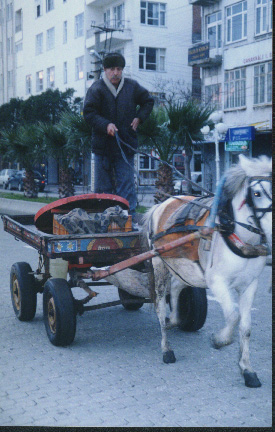 There were lots of these little horse and carts coming through the town all day. The ponies didn't seem to mind the traffic at all. They drive cars on the right-hand side of the road in Turkey. |
||
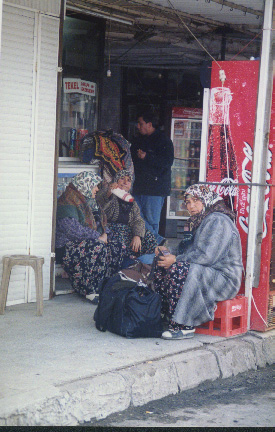 These ladies were waiting for a bus. They have their heads covered with a scarf, and are wearing very long skirts. Most women in Turkey wear this style of clothing as it is part of the Muslim religion to do so. Notice the Coca-Cola machine in the picture. These machines were everywhere. Coke is a very popular drink. |
||
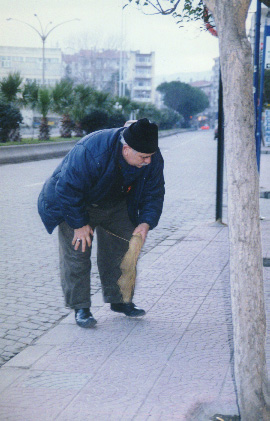 Keeping the shop front clean is just as important in Turkey as it is in New Zealand. This man is using a small brush to sweep the footpath outside his shop. It is still early in the morning and it was cold so he is wearing a woollen hat to warm his head. This is the main street of Canakkale. On the other side of the road is a large town square with a school on one side. |
||
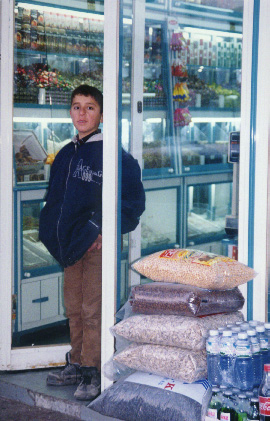 This young boy was waiting for customers to come along and buy. He smiled at me and invited me to enter his shop. The large plastic bags contain different kinds of nuts. Bottles of water and Coke are in the corner of the picture. Many Turkish people can understand some English. Everyone was very friendly and helpful. They seemed very kind towards New Zealanders because of the connection with Turkey at Gallipoli. |
||
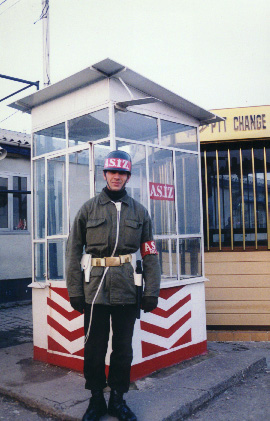 Canakkale is still a very military place. This soldier is waiting by the entrance to the car ferry to go across the Dardanelles. He was very friendly and when I showed him that I wanted to take his photo he made sure his jacket was tidy and straight so he looked his best. |
||
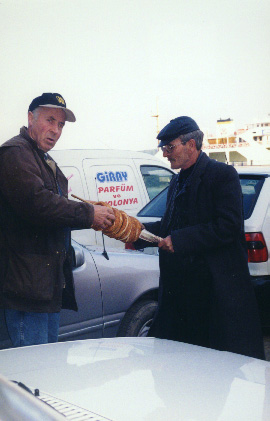 The round bread was easy for passengers on the car ferry to buy. It was on a straight stick and you took off how many you wanted. This was a slightly different flavour too. |
||
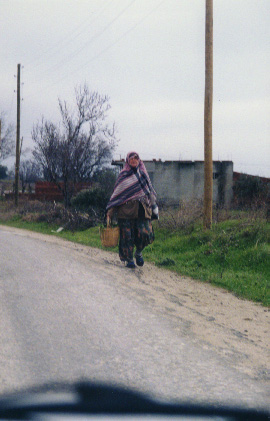 Walking to a small village outside Canakkale. This lady must have walked quite a long way as I could not see any houses for some distance. Again, she has her head and legs well covered. |
||
|
Restaurant 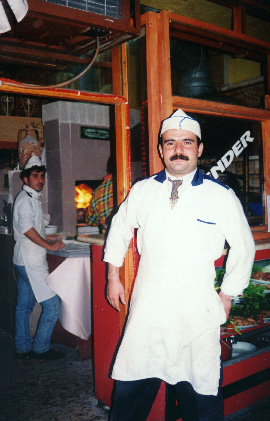 Often people from a restaurant or shop would be standing outside trying to get the customers to come in and buy. This man in Canakkale was just about to ask men into his restaurant. |
||
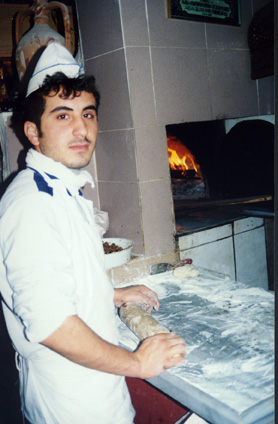 Often too, all the bread is cooked in front of the customers. This man is preparing the bread for baking in the oven. |
||
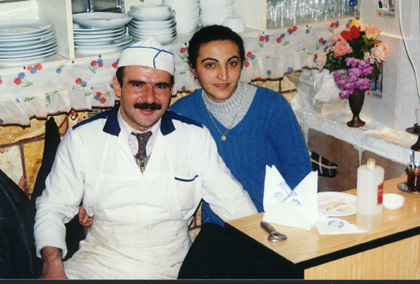 Everyone was very interested in foreign visitors. We had to meet all his friends and family. Here is the owner who wanted me to meet his girl friend. |
||
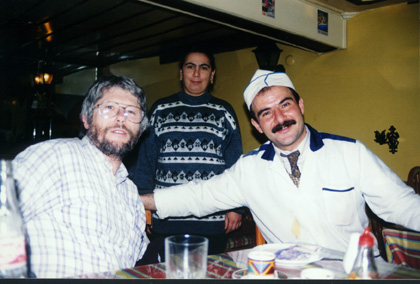 When I sat down he wanted to come and chat to us. |
||
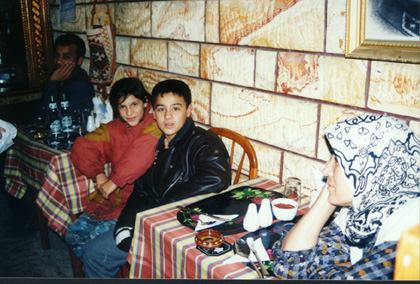 We had to meet his sister and little brothers. |
||
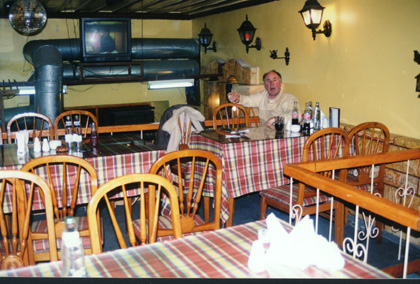 The restaurant was very small. We were stuck up near the roof where we could watch other people coming in, or look at the television if we wanted to. |
||
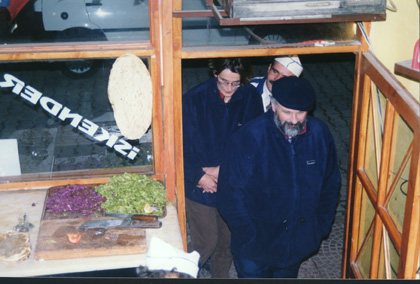 Here is the owner again, getting more customers in off the street. Notice all the food displayed in the window for the customers to look at. |
||
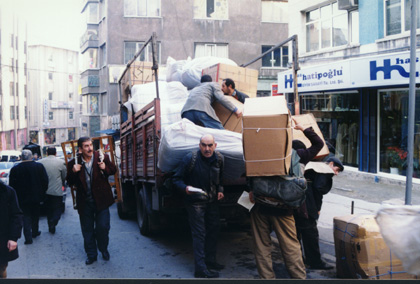 Istanbul used to be called Constantinople. It is a very crowded city. Where traffic could not get through everything would be carried on the back. Heavy boxes had to be carried on the back. Look at the man on the left. He has a wooden frame on his back to help carry boxes on. |
||
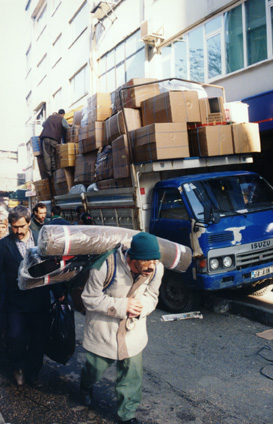 Another man carrying a heavy load up the street. The roads were blocked with traffic, so it was quicker to walk. |
||
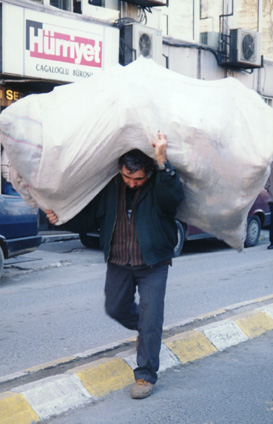 A man in a hurry. |
||
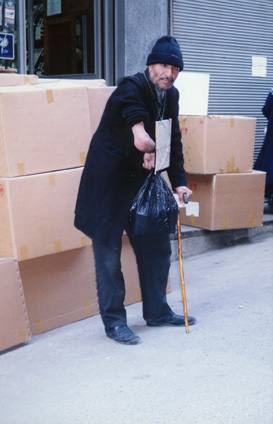 There were quite a few very poor people too in this part of town. This man was begging for money. |
||
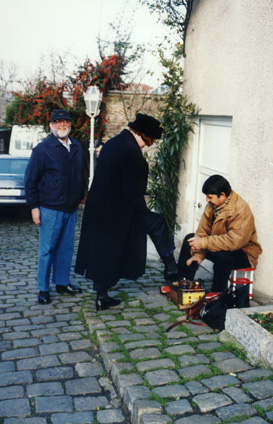 One very handy thing was being able to get your shoes shined at the side of the road. |
||
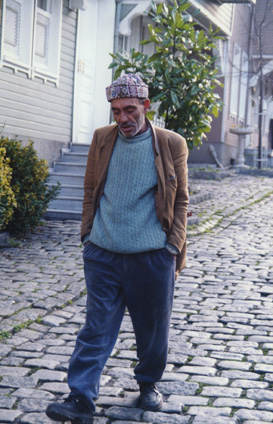 A Turkish man wandering along, deep in thought. Notice the road stones, called cobble stones. This kind of roading is very common in old parts of town. It is very noisy to drive over in a car. |
||
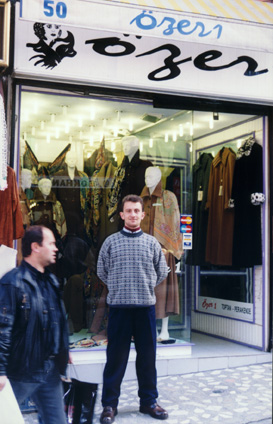 Yet another man trying to get customers into his shop. He tried very hard to get me in there, but unfortunately for him, I didn't need a coat for a lady! |
||
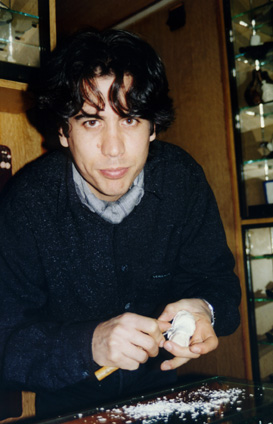 This man's job was carving faces on smoking pipes. He used a soft stone and very quickly made beautiful shapes out of the stone. |
||
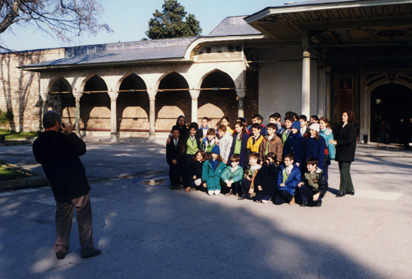 Just as in New Zealand, school children go for class trips to see interesting things. This class was visiting the Topkapi Museum, where much of the interesting history from the days of the Sultans is stored, along with beautiful clothing, pictures and jewellery. |
||
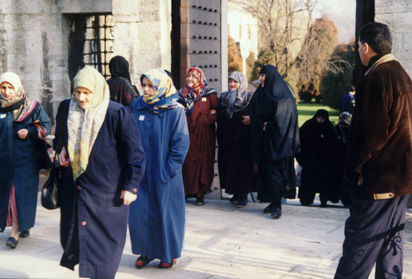 Muslim ladies visited a beautiful temple called "The Blue Mosque". This is right in the centre of Istanbul, and is many hundreds of years old. |
||
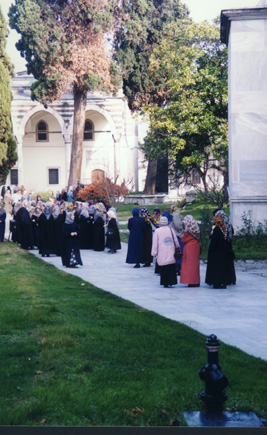 A class of Muslim school girls visited the Topkapi Museum, too. |
||
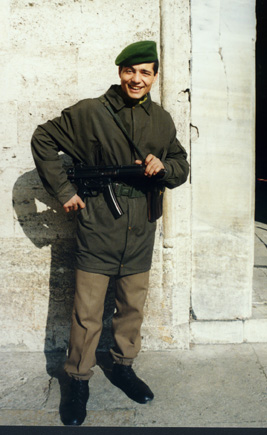 One of the armed soldiers guarding the Museum and jewels. That is a real machine-gun he had. There was another guard on the other side of the doorway. |
||
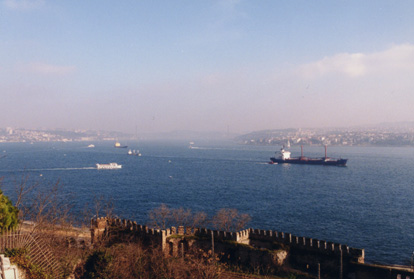 The Dardanelles lead into the Sea of Marmara. Istanbul is at the end of the Sea of Marmara. The waterway becomes very narrow here. The waterway is now called "The Bosphorus". It is an extremely busy shipping lane, going up to the Black Sea and Russia. It was this shipping lane that the Turks had blocked in 1914, not allowing the Russian ships out, that the British wanted opened again. That was the first reason for the battle at Gallipoli. |
||
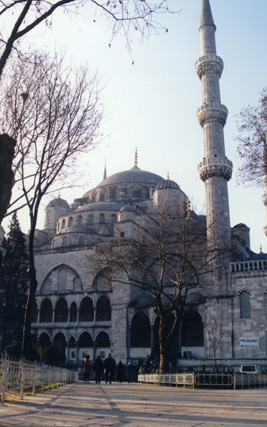 The beautiful Blue Mosque. The tall towers at the sides are called minarets. They are used by the priest to call the people to prayers. This building is right in the very centre of Istanbul. |
||
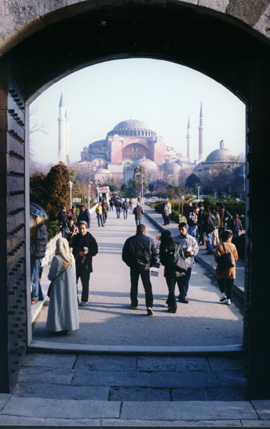 Immediately down the road is St. Sophia. It began life as a Christian Church over 1000 year ago. It is now also a Moslem Mosque. |
||
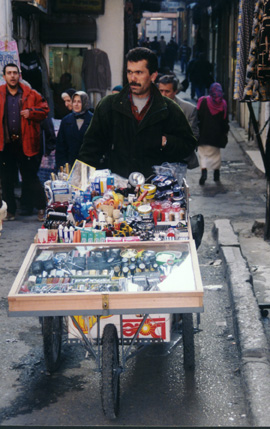 In the narrow streets of Istanbul people would try to sell anything. This man has a wheelbarrow as his shop on wheels. |
||
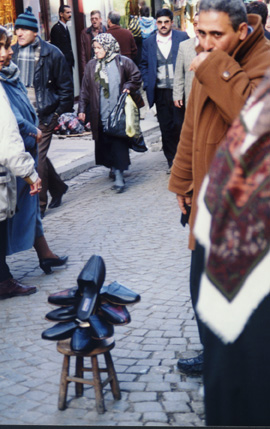 Would you like a pair of shoes? Right in the middle of the road this man was selling these shoes. Notice the pattern in the cobble stones. This pattern is very common right across Europe. Notice too, the man in the background trying to get customers to come into his shop. |
||
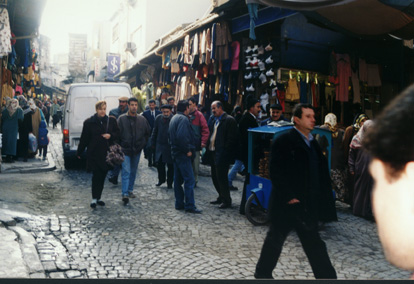 Looking up the street, it was a mass of people and small shops. |
||
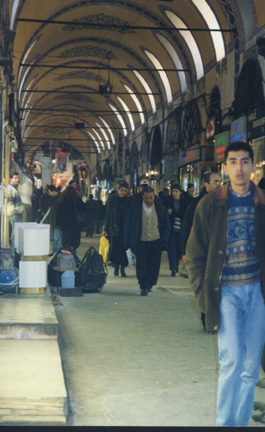 The shops in this place, called "The Grand Bazaar", have been here for over 500 years. |
||
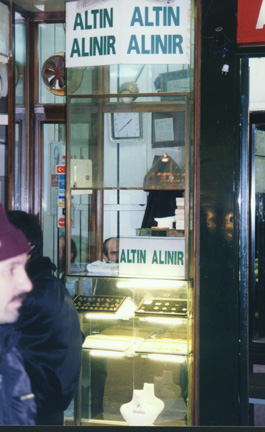 Space is limited. This man's shop is just 1.5 metres wide. |
||
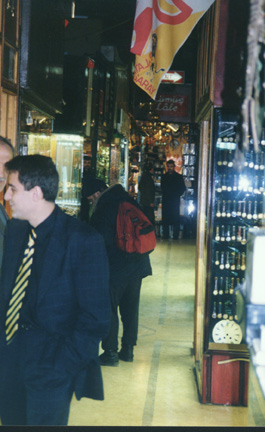 The whole area is a crowded mass of tiny shops. This part was just for gold and jewellery. Other parts had clothing, or bags, or food. |
||
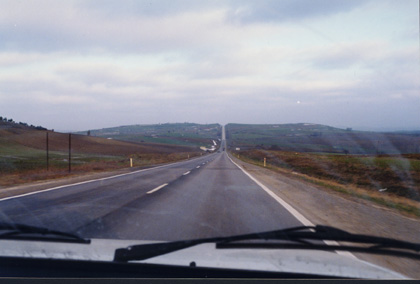 The long straight road down the Gallipoli Peninsula. Notice we are driving on the right-hand side of the road. It had snowed the previous week and in places drifts of it were still beside the road. |
||
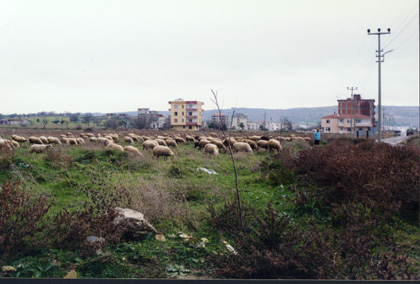 Sheep grazed the side of the road in places. No fences though. A man with a dog was always looking after them. In New Zealand the sheep would go in front of the farmer. Here the sheep always followed him. |
||
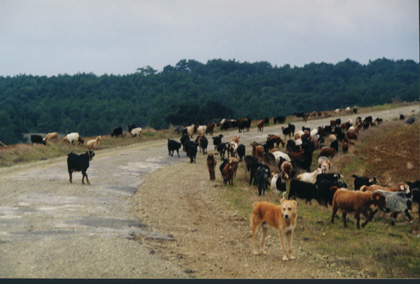 Dogs were guarding this herd of goats. |
||
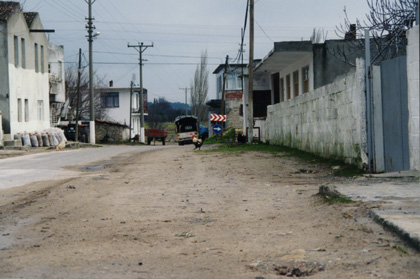 One of the little villages near Cape Helles. |
||
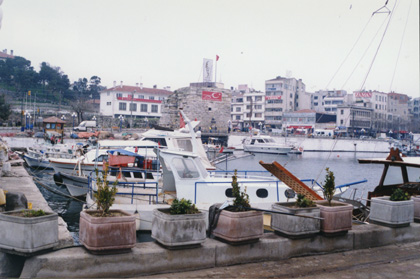 The boat harbour at Gallipoli. |
||
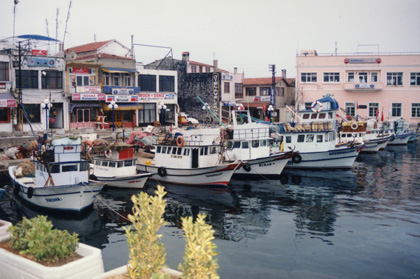 Fishing boats were tied up close together. |
||
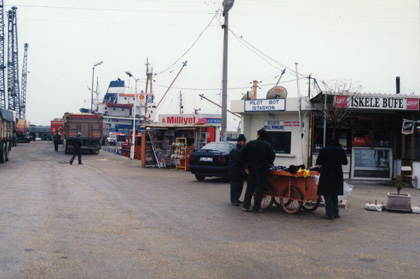 Gallipoli is also the place where big car ferries take vehicles over to Canakkale. There is no bridge, so going by ferry was the only way across. |
||
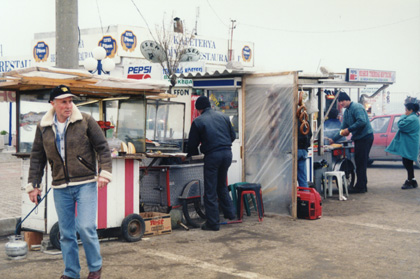 If you were hungry there were plenty of little carts selling fast food. |
||
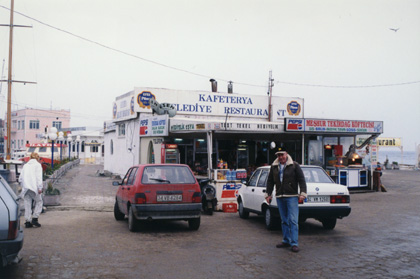 Plenty of parking, too. In summer this place would be really packed out. |
||
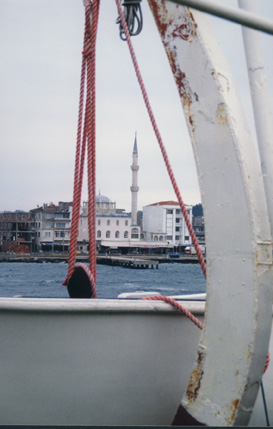 A view of one of the mosques in Gallipoli from a car ferry. |
||
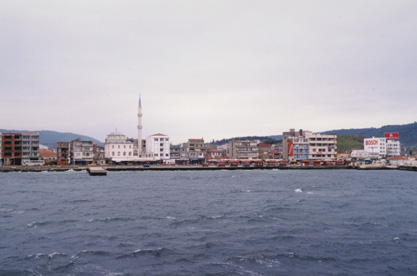 Gallipoli town centre is on the flat. The new part of town goes up the side of the hill behind. This was where the German General Liman Von Sander, who was in charge of the Turkish Army during the battle, had his Headquarters. It was from here that Colonel Kemal marched his men to the sound of the guns on 25 April 1915. |
||
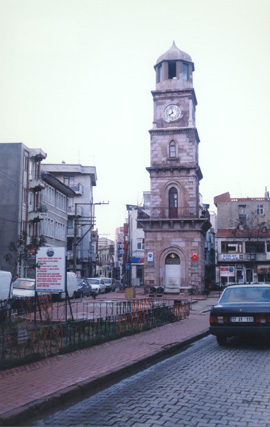 Right beside the water front in Canakkale is the town clock. As with many Turkish towns, the streets are very narrow. They definitely were not built for cars! |
||
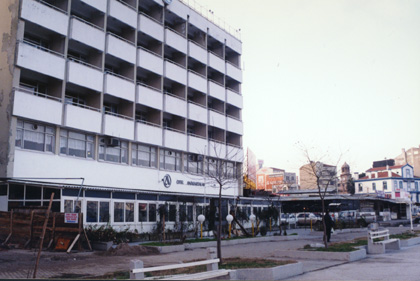 Canakkale looks after lots of visitors to the battlefields, such as myself. There are hotels all along the waterfront. You can just see the clock tower in the distance. |
||
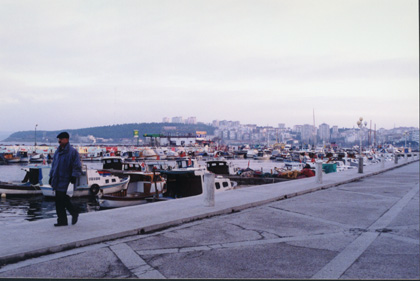 Canakkale is a busy port with a lovely waterfront. |
||
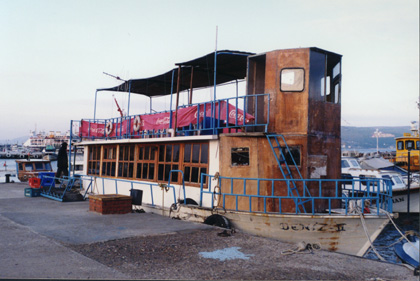 There were some interesting looking boats in the harbour. This one was set up to take people for rides up the Dardanelles. I'm not sure I would care to travel on it, however! |
||
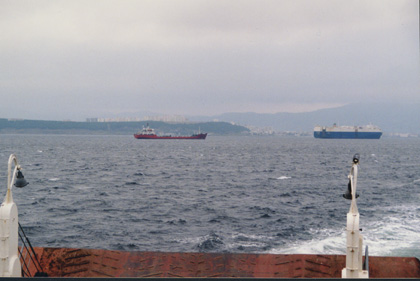 Some of the shipping traffic constantly passing up and down the Dardanelles. |
||
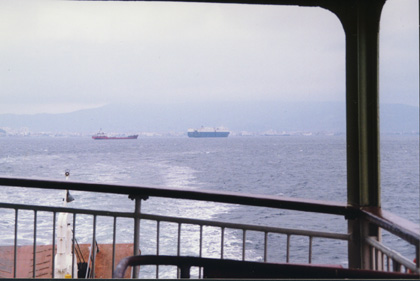 Looking back to Canakkale. |
||
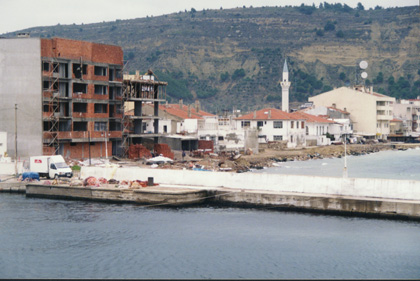 Eceabat is one of the towns across the water from Canakkale. In 1915 the town was called Maidos. |
||
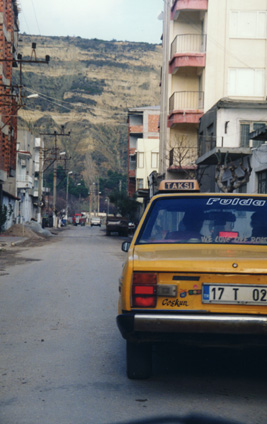 Narrow streets in Eceabat. |
||
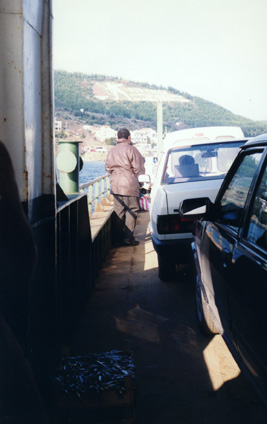 Kilidbahir is the village straight across from Canakkale. The fort here was the other main one the British Navy were trying to destroy in the attack on 18 March 1915. |
||
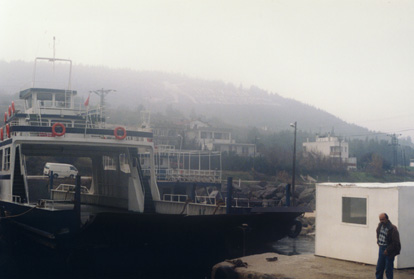 Kilidbahir is a little village tucked against the hillside opposite Canakkale. This car ferry just pulls in against the bank and unloads the cars. It also takes school children over to Canakkale each day. |
||
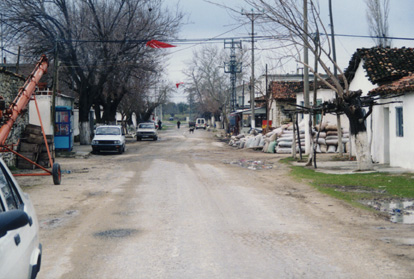 One of the small villages by Seddul Bahir near Cape Helles. |
||
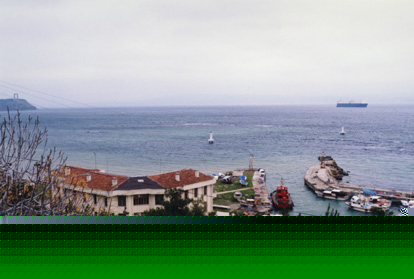 Boats travelling up the Dardanelles must have a pilot to steer them. This is the little harbour they come from at Cape Helles. |
||
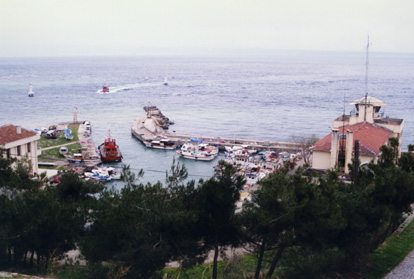 The pilot boat is just arriving. The Seddul Bahir Fort is straight behind me as I took this photo. |
||
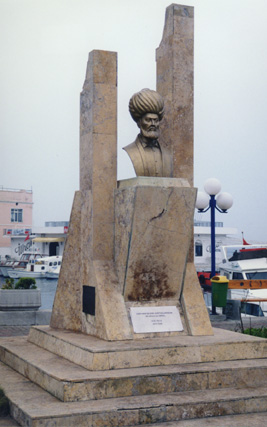 In the Square at Gallipoli are two statues. The first is for Admiral Reis who in the 1500s mapped parts of the Mediterranean Sea. |
||
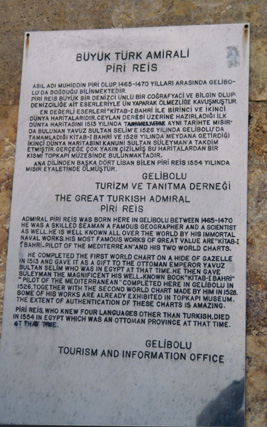 The plate on the side of the statue for Admiral Reis. |
||
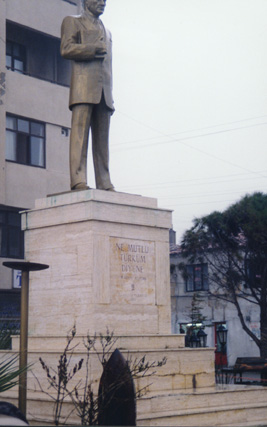 The other statue is of Mustafa Kemal Ataturk. |
||
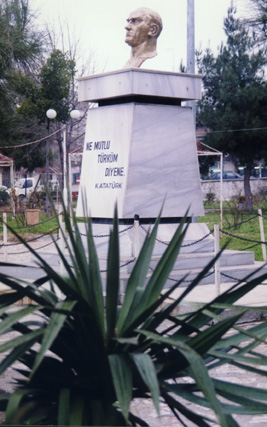 As well, there is this bust of his head. |
||
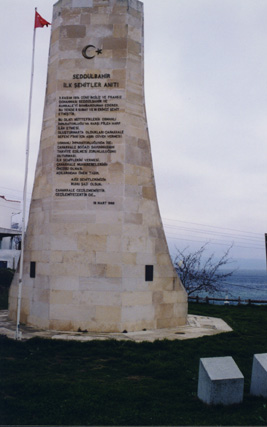 Seddul Bahir Fort at Cape Helles has this memorial to the 18 March 1915 battle. |