
 |
Mustafa Kemal Ataturk was born in Salonica (then part of Turkey, but now in Greece) in 1881, died 10 November 1938. As a military man, he had an amazing record. He never ever lost a battle. 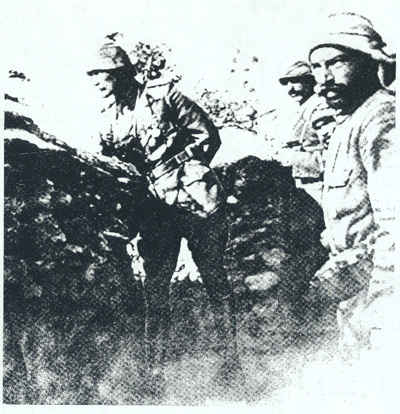 In 1915 he was Colonel in charge of the Anafarta (the name of a small village near the Anzac landing site) section of the Gallipoli Peninsula. This was the very landing area of the Anzacs. Had he not been there at the exact time he was, the landings might have been successful. Hearing the battle noise, he rushed his men, without waiting for orders from the General in charge, to the top of Chunuk Bair. From there he saw the landings and knew immediately that the key to saving the whole Gallipoli Peninsula was to make sure that Chunuk Bair, and the other hill tops, were not lost. 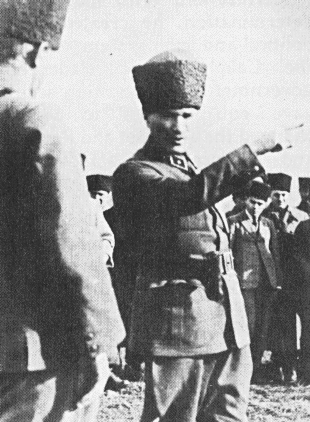 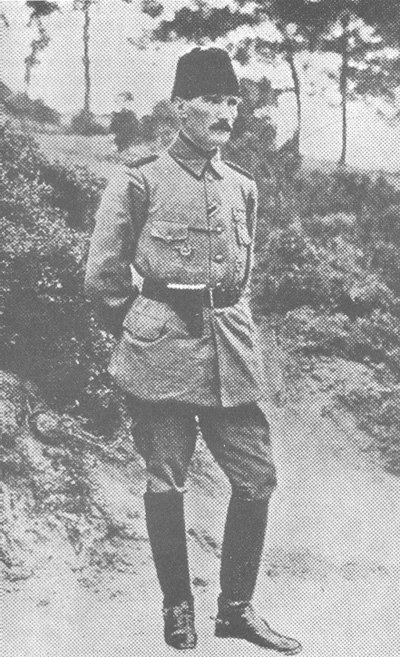 By his personal genius and bravery he was able to lead the Turkish soldiers and stop the Anzac advance on the morning of 25 April 1915. He did not leave the battle zone again until after the Allies had evacuated the peninsula in December 1915. His life was saved on one occasion by his pocket watch, which stopped a bullet hitting him in the heart. 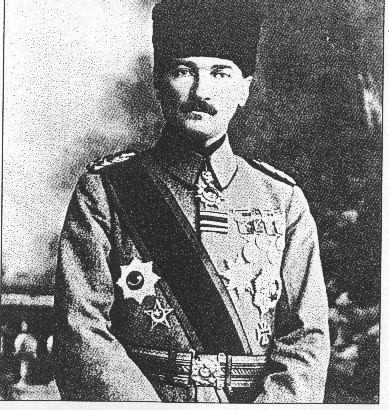 (Moorehead, GALLIPOLI) |
|
|
General Birdwood was wounded in the head on the same day as General Bridges was shot in the thigh. Birdwood recovered from this wound and continued in command. In this photo General Birdwood (on the right, in the light uniform) is seen with Lord Kitchener, when Field Marshall Kitchener visited Gallipoli himself to see exactly what was going on. He wanted to decide whether or not the Allies should withdraw from the Peninsula. 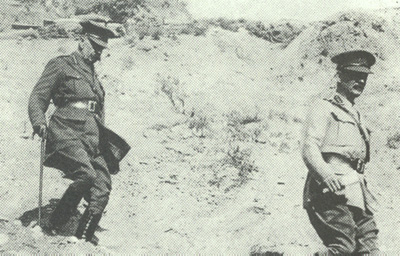 (Imperial War Museum) |
||
|
Major-General Sir William Bridges, General Officer Commanding Australian Imperial Force. General Bridges was hit in the thigh by a sniper in Shrapnel Valley and he died of his wounds on 18 May 1915. 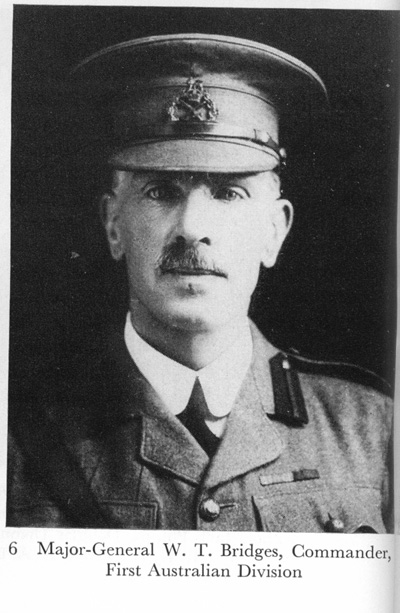 (Q.E.II Army Museum, Waiouru) |
||
|
Right Honourable Winston Churchill. First Sea Lord of the Admiralty. (1874-1965) (Note that he was not in the British Navy. He was a politician with responsibility for the Navy.) 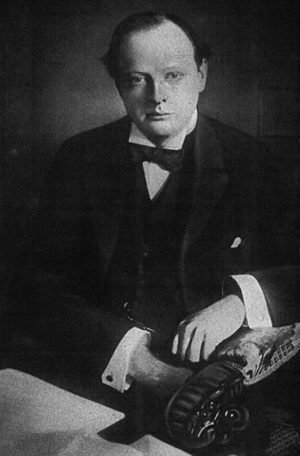 Winston Churchill was the British politician who came up with the idea of the Dardanelles campaign. He then passed the idea on to Lord Kitchener (the Secretary for War) to put into operation. The first plan was for the British Navy to attack the forts with battleships, pass through the Dardanelles Strait and go on to attack Constantinople. (Now called Istanbul). If plan one failed, then plan two would be to land soldiers on the Gallipoli Peninsula, attack and capture the forts from behind, allowing the battleships to pass through to attack Constantinople. Once Constantinople had fallen, it was thought that Turkey would withdraw from the war, allowing Russian ships to safely pass through the Dardanelles. Britain could then also send soldiers to march overland and attack Germany from behind, bringing the war to a quick end. Churchill was involved in very many arguments with generals and politicians in Britain and France, trying to get his ideas through. Some of these problems were of his own making, some caused by others. The result was endless delays in making important decisions, all of which eventually helped to cause the failure of the plan. When it was clear that the campaign had failed, Churchill was forced to resign. For many years his name linked with the failure at Gallipoli, and the on-going bitterness people felt towards what had happened. Winston Churchill later recovered his reputation when he became Prime Minister of Great Britain during World War 2. He became a very great and famous leader of Britain. Some people say he was one of the most important politicians of the 20th century, even despite of the disaster at Gallipoli. Today, (1999), it is usually thought that his idea was right. It was just the terrible, muddled way in which it was carried out that was wrong. |
||
|
Major General Sir Alexander Godley. (1867-1957). Commander of the New Zealand Expeditionary Force 1914-1918. General Officer Commanding New Zealand and Australian Division 1915. 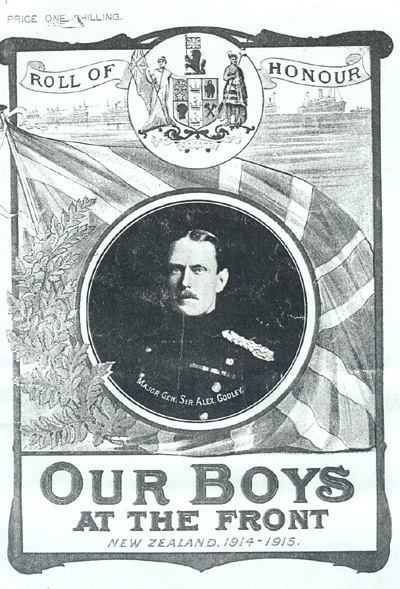 Born in England, and part of the British Army, General Godley came to set up the New Zealand military training schemes in 1910. A very able administrator, he quickly built an effective military system with untrained, but very keen men. Leading the Main Body of soldiers leaving New Zealand in October 1914, he was placed in charge of the New Zealand and Australian Division at Gallipoli. This strange mixture of soldiers came about as New Zealand numbers were too small on their own, while Australia had extra men who were able to be used to increase the New Zealand numbers. A very strict man, the New Zealanders hated the training he made them do in Egypt before going to Gallipoli. Later however, they would thank him for this work in this area. He was also very sparing with praise and medals, believing that every man should just do his job. Only one Victoria Cross was given to a New Zealander during the whole campaign, while a British battalion gave 6 on one day, and the Australians gave 7 on the attack at Lone Pine. This attitude did not make him popular with the soldiers, either. His wife was with him in Egypt. She too did not help his popularity, when the soldiers thought she was saying things about them, especially about making them work harder during training. While on Gallipoli too, he never talked much to the soldiers, often just passing them by in silence. Neither did he share the difficult conditions they were living under. He had much more comfortable surroundings in his Headquarters near the beach. Eventually, the New Zealand soldier's opinion of Godley seemed to be that he did not really care about them very much. It seemed to them, that he would let the other British generals send New Zealanders to do impossible tasks and get killed for nothing. The men complained too, that General Godley let them down by not providing them with the right planning or equipment to do the job. In coming to New Zealand in the first place, General Godley rather thought that he was coming somewhere not very important. Perhaps it was this attitude which made him both determined to be "professional", (to not give out praise, and to think that everyone should just do their duty), while at the same time it made it difficult for ordinary New Zealand soldiers to get on with him. In the end, many New Zealand soldiers were very bitter about General Godley as a leader. |
||
|
Commander- in -Chief of the Mediterranean Expeditionary Force. (General Hamilton is in the centre holding on to the pole) The British Navy and Army leaders at Gallipoli. They are on the armed private boat 'Triad'. General Hamilton used this boat often during the Gallipoli campaign, as he moved around the Gallipoli Peninsula trying to find out what was going on. From the left, Commodore Keyes, Vice-Admiral De Robeck, General Hamilton, Major-General Brathwaite 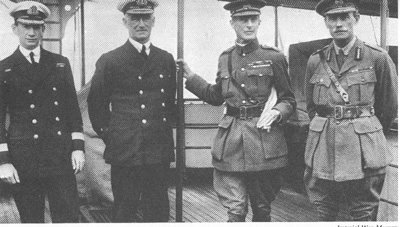 (Imperial War Museum) General Sir Ian Hamilton is the man holding on to the pole. His left arm is at a funny angle, the result of an injury in a previous war in Afghanistan. On his left is Major-General Brathwaite, one of his headquarters generals, while on his right is Vice-Admiral De Robeck who was the leader of the British Navy. On the end is Commodore Keyes, who was the British Navy second in charge. General Sir Ian Hamilton was 62 when he was appointed by Lord Kitchener to command the Mediterranean Expeditionary Force. He was suddenly appointed when it was realised that the British Navy might not get through the Dardanelles by themselves, and a back-up plan might be needed. Appointed on 13 March, he was given just a few weeks to put everything together. He was given confusing orders and muddled instructions as to how to carry out the orders. Nothing was known about the Turkish forces, and a lot of guesses were made. They turned out to be wrong. Even the maps were wrong. In turn he created muddle and this sense of confusion continued on through the whole campaign. As a leader, once the landings were under way he made a continuing series of errors of judgment which caused many deaths, and which eventually led to the final defeat and withdrawal from Gallipoli in December 1915 and January 1916. These errors of judgment included appointing generals who simply could not do the job he required of them. Perhaps the greatest of all their mistakes was that they never learned from their mistakes, and just kept on doing the same things over and over again. His role perhaps could be summed up as that although he tried hard, he was given an impossible job to do in too short a time with the wrong sort of equipment. |
||
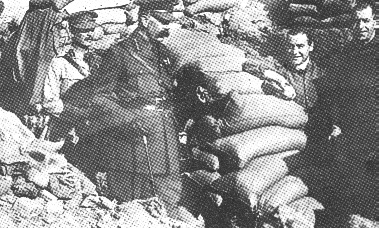 (Queen Elizabeth II Army Memorial Museum) Field Marshall Kitchener was the general who was responsible for running the whole of the First World War, until he was drowned in a battleship when it sank in 1916. Lord Kitchener never thought the Turks would fight very hard and he very badly underestimated the amount of men and equipment needed to capture the Gallipoli Peninsula. He was so busy arranging the fighting in France that he did not give enough thought to what was required in Turkey. He thought Gallipoli was going to be something of a 'sideshow'. It was only near the end when he had visited the place that he actually really understood how impossible the task was he had set the soldiers. By then he was too late. |
||
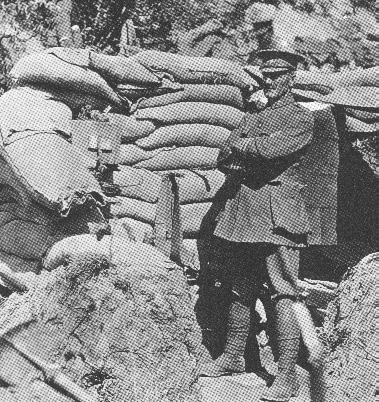 Lieutenant-Colonel Malone is standing outside his dugout. Just by looking at the way he is standing you can see he is a very determined man. Born in England, Colonel Malone was a farmer from Stratford, in Taranaki. He was well over 50 when he went to Gallipoli. A perfectionist, so that everything had to be just right, he did not get on well with many of his fellow officers. They found him difficult to work with. He drove his Wellington Infantry Battalion very hard in training, but later it was they who many times saved the Anzacs by keeping control of Quinn's Post during the terrible days of June to August. He said, "The art of warfare is the cultivation of domestic virtues". Meaning that, by keeping things neat, tidy and organised, the soldiers could get better control over what they were doing. He refused to allow his Wellington men to make what he thought would be suicidal attacks, sometimes refusing direct orders from his leaders. He personally led the successful attack by the Wellington Infantry Battalion which at last captured Chunuk Bair, and he was killed there. Quite possibly, he was killed by New Zealand artillery as they tried to shell the Turks on Chunuk Bair, but hit their own men by mistake. While he led the successful attack on Chunuk Bair, he was also the soldier the Generals decided to blame for not holding the hill top. They said he did not get his men into trenches in the proper places. Comments like this made the New Zealand soldiers very bitter about the generals. The ordinary soldiers thought the dead were being blamed for the incompetence of the generals. Though they never met, it is interesting to see how similar in attitudes to leadership Lieutenant-Colonel Malone is to Colonel Mustafa Kemal. Lieutenant-Colonel Malone was attacking Chunuk Bair, while Colonel Kemal was defending it. Both men wanted things done their way, and made sure it happened through very strong leadership. Both thought very highly of the bravery and courage of the men they lead. |
||
|
Corporal Bassett was the only New Zealander to win a Victoria Cross for bravery on Gallipoli. He was awarded it for gallantry while putting out signal wire on 7 August 1915, during the attacks on Chunuk Bair. A very modest man, he did not talk about his medal at all, even to his own family. He said, "All my mates got were wooden crosses". 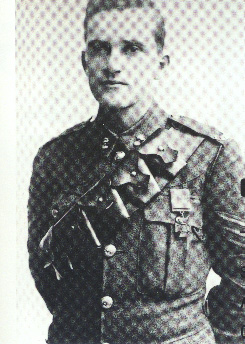 |
||