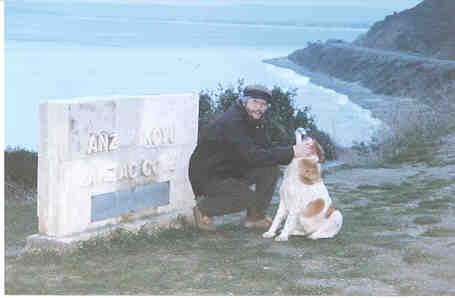
The day I first arrived at the Cove in January 1999, it was pouring with rain. And to my astonishment, a dog was living there. My friend Mike and I had joined a tour group for the day. Our guide, Captain Ali Efe (who was a retired Turkish submarine captain), said that the dog had been living there for 3 or 4 years. No one owned him; he was a stray dog, and he lived off scraps of food given to him by tourists and visitors, such as ourselves. 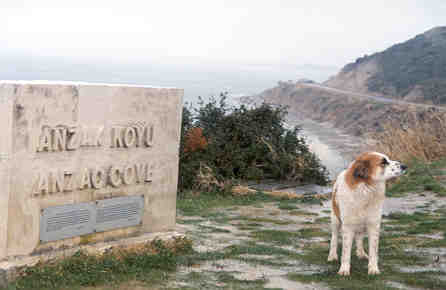 I climbed down and walked along the beach to the far end. The beach is just 700 paces long, and about 40 paces deep to the edge of the bank. The road was not there in 1915. It was built by the Anzacs. Captain Efe laughed and said, "Thanks for leaving us the road. It was one of the few good things to have come out of the battle". |
||||
|
The dog was very friendly, and I couldn't help patting him. He followed us up to the other end of the beach too. The Turkish name for the point at the far end (or northern end) is Ari Burnu. |
||||
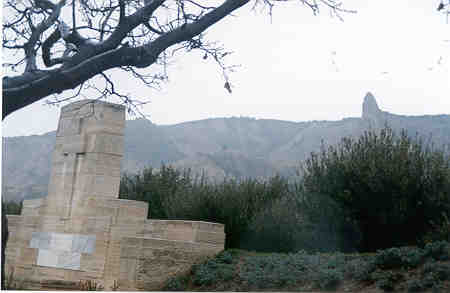 This is the northern end of the Anzac Cove beach, the point called Ari Burnu. You will see it in other photos taken later from up on the hill. Every cemetery has a cross and graveyard similar to this one. Behind the view of the cross at Ari Burnu Point Cemetery, you can see the unusually shaped hill point, which the Anzacs quickly named, "The Sphinx", after the Sphinx statues in Egypt where the soldiers had just come from. |
||||
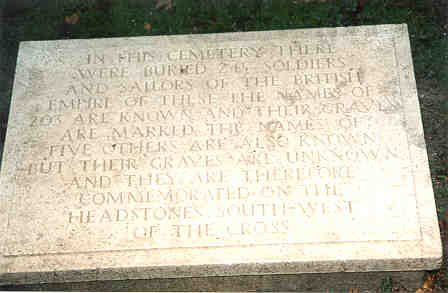 On the Ari Burnu headland, there is a graveyard. There are many cemeteries all over the battlefield. The soldiers were buried close to the areas where they died. This is a photo of the headstone in front of the cemetery. Every cemetery had a headstone similar to this one at the entrance explaining who was buried in the cemetery. |
||||
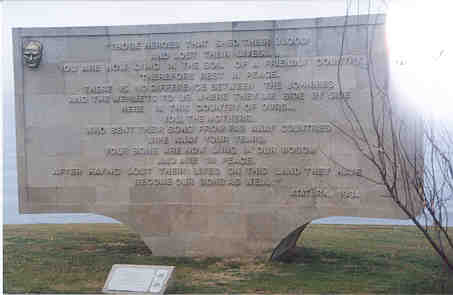 Go to Mustafa Kemal Ataturk Memorial, Wellington, New Zealand "Those
heroes that shed their blood and lost their lives The Turks had a very clever soldier on their side who was later to become a great leader of his country. He was not the top general, but he wound up controlling many of the important battles. He later became the first President of Turkey. This man's name was Mustafa Kemal. Later he was known as Mustafa Kemal Ataturk (which means Father of the Turks). There are many memorials and statues of him all over Turkey, and especially so at Gallipoli. |
||||
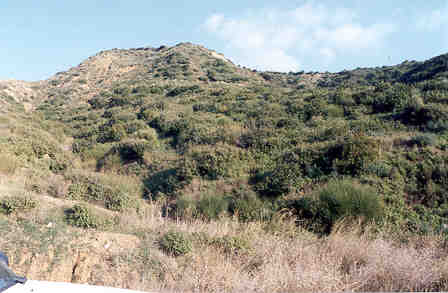 Plugge's Plateau is at the top of this hill at Anzac Cove. Arthur Plugge was the New Zealand Lieutenant Colonel in charge of the Auckland Infantry Battalion. At home he was Headmaster of Dilworth School, Auckland. He made the headquarters of the Auckland Infantry Battalion on the top of this hill. On the morning of 25 April 1915, there was no communication between units and no organisation on the beach, nor any room to get organised. The men were in the wrong place and just had to get on with it as best they could. The hill at Anzac Cove is only 100 metres (300 feet) high, but is steep and awkward to climb. It was, and still is, covered with a thick low, prickly bush, rather like gorse. This picture is taken from the road, looking up the first hill they had to climb, just to show how steep it was. At the top it is quite flat, and they called that area Plugge's Plateau. Men scrambled to climb other hills or rushed into gullies and valleys. There was confusion everywhere, as men got lost, wounded and killed. |
||||
|
||||
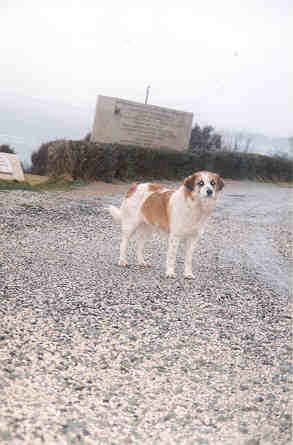 It was so wet that day we decided to leave and come back the following day when the weather might have improved. As we left, there was our friend, the dog, standing in the rain, and watching us leave. |